 United States
US
United States
US










How To Stay Productive With Irregular Schedules (For Online English Teachers)
Join a global community of over 200,000 TEFL teachers working throughout the world! Enrol me!


 December 9, 2025
Teaching English online offers flexibility and freedom — but with that comes the challenge of managing an often unpredictable and irregular work schedule.
Whether you’re juggling students across time zones, squeezing in lessons between travels, or adapting to last-minute bookings, staying productive can feel like a moving target.
After four years of teaching English around the world in Spain, South Korea, and Türkiye, I was ready to take this show on the road with my girlfriend. We’ve been teaching online, bouncing around the world for the last two years, and are ready to share our tips and secrets with you!
Read more: How To Overcome Online Teaching Challenges While Travelling
Understanding irregular schedules
One of the main appeals of teaching online is the flexibility to literally teach anywhere in the world. Yet, as you and I both know — the world is HUGE, and that means there are 24 time zones. That, for sure, can set the stage for an irregular online teaching schedule, especially if you’re on the move and bouncing across time zones.
This is a huge factor that you need to consider before setting up a base for your online teaching adventure. Thankfully, there are many teaching platforms with students from around the world that can accommodate your schedule.
However, currently, many of the largest teaching platforms cater to students located in East Asia. If you choose to work with these platforms, this means that you are more or less tied to this time zone based on the availability of your students.
If you’re working with children, you are generally going to have the best chance to fill up your schedule between 4 pm–9pm. Chinese, Korean, and Japanese time zones. Therefore, depending on where you are, this could be your morning, afternoon, or nighttime.
Read more: How To Teach Young Learners From Asia Online Effectively
Latin American students are fast becoming another top market for online teaching platforms. This might be more suitable for teachers based in the US.
After two years of teaching online around the globe, I want to highlight the difficulty of working with different time zones. To effectively adapt to this, you need to be flexible and patient.
If your time slots are in the early morning or late night, you need to be prepared to be up at that time because this is your income. We were able to tackle this by remaining in a certain region of the world for an extended time while going between countries.


For example, we spent six months in Asia, which gave us a more stable routine for our mostly Polish-based students.
When we moved to Europe for the next few months, we had to completely alter the schedule and establish a new routine. This was difficult at first, but after a week or so, we were immersed in our new schedule.
We recommend that you travel this way — spending months at a time within a particular region where there are minimal time changes between countries. If your students are Chinese-based and you start in France for a month, then move to Uzbekistan the next month, and then to the US the following month, you are making it harder on yourself to adapt and maintain a routine.
Luckily, we are young and flexible enough to adopt new sleeping routines. But this isn’t for everyone… so plan accordingly!
There are many advantages to working irregular hours online.
Firstly, you have variety in your days and can spend your days or nights doing different things compared to other days when you might be working those hours. As we yearn for adventure, we find this routine to be exhilarating and making each day more or less interesting than the last!
Productivity strategies for irregular routines
Dealing with irregular routines can certainly be a handful, as your mind and body work to adjust to changing time zones.
Use a scheduling app
For scheduling, we recommend using some sort of calendar application to keep track of time changes.
We use Google Calendar, which has been great for logging particular classes and potential changes (e.g. daylight savings). With a full schedule of private students and students from multiple applications, it becomes quite the jumble.
Google Calendar is a lifesaver, and there are many other planner applications out there — don’t try to keep track of time zones on your own. We learned that some countries do daylight savings at different times, and we certainly would’ve missed classes had we not used Google Calendar.
Simplify and prioritise
When you have short notice or fragmented time to prepare a lesson, the best approach is to simplify and prioritise.
Start by identifying one clear goal for the lesson — what’s the single most important takeaway for the student?
Thankfully, we live in the age of the internet, making it easy to use it to your advantage when it comes to lesson prep! Some useful sites that we use are Elli (paid subscription) and iSL Collective (many free resources).
However, you are more than welcome to come up with your own materials or plans! The power is yours!
Read more: 7 Reasons You Should Make Your Own EFL Worksheets
Mindset & motivation tips for online teachers
Without a traditional schedule, it’s easy to feel adrift. We like to stay anchored by:
- Setting weekly intentions: At the beginning of every week, we outline two or three goals. These could be related to both teaching and leisure activities. Google Calendar has become our best friend in terms of having a visual of our day-to-day schedules ahead of the week.
- Creating daily rituals: When it comes to working remotely, it’s important to take the initiative to create your own routine. Every day, we ensure our schedules are open at the same times for meals — just like a “lunch break” during a conventional in-person job. We also schedule time during the week to go to the grocery store and plan meals. This is extremely important in maintaining a routine and feeling grounded, no matter where in the world we are.
One of the biggest questions we are asked as online teachers is: “How do you separate ‘work mode’ from ‘home mode’ when they both happen in the same space?”
Well, the answer is simple — there’s a time for work and a time for play. We devote certain hours, much like a traditional job, to work, and the rest to travel and exploration.
We don’t sit around all day when we aren’t working. That’s our time to go out and experience the city we’re living in. We stick to our schedule and try not to blur the line between work and play. The location doesn’t matter — what matters is how we spend our time to achieve a healthy work/life balance.
You have to be flexible and creative in this profession. If you’re feeling tusk in a rut, change your scenery (e.g. working in a café instead of at home) — the flexibility is yours.
You can also rearrange your schedule to better meet your needs. The beauty of online teaching is that you have more freedom — take advantage of it!
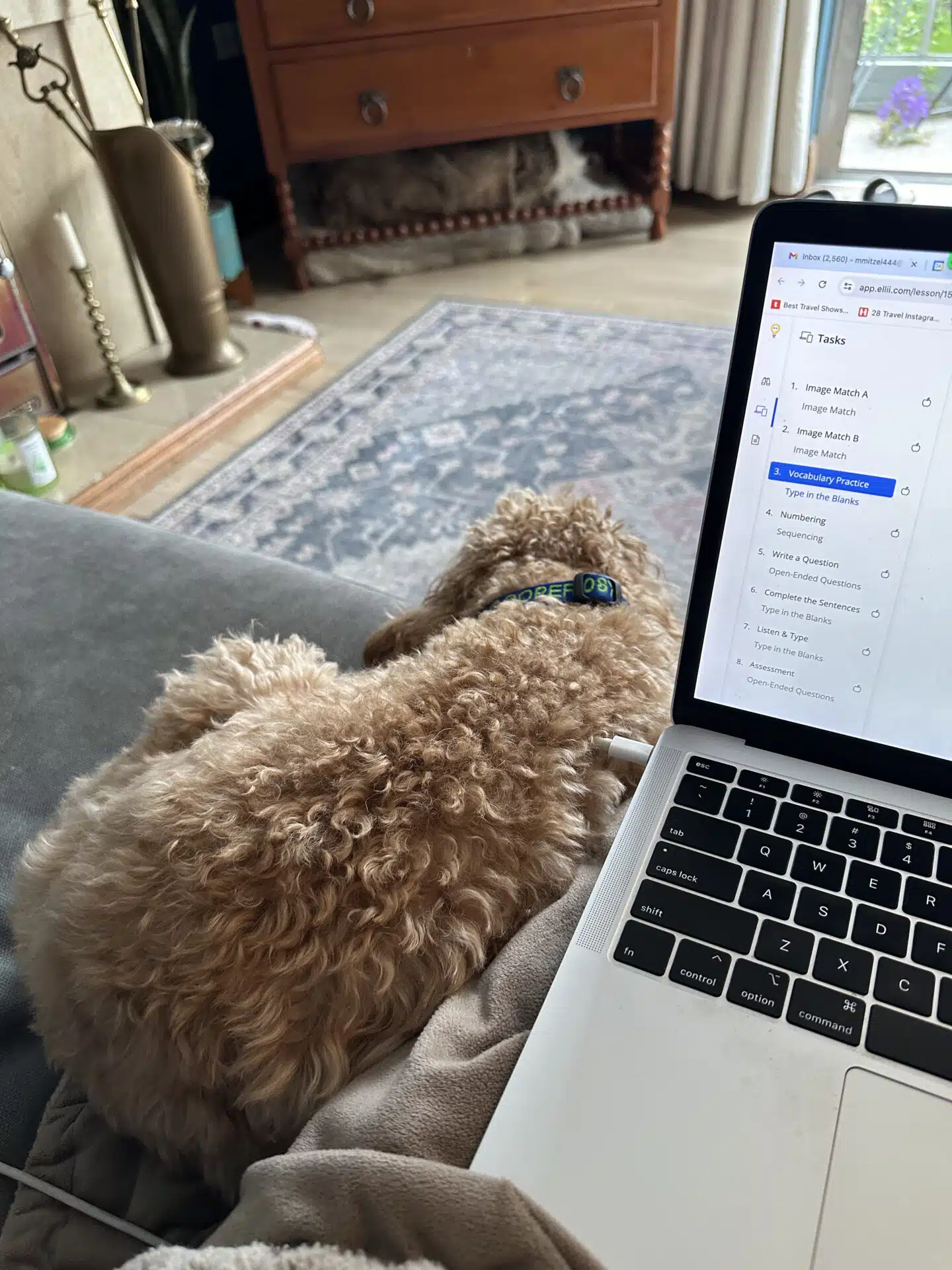

An average weekly routine (even with an irregular schedule)
An average week is hard to characterise, as each day can be different.
Additionally, depending on your time zone, your average week may look a little different. For example, an average week in Taiwan might look very different from one in Colombia.
This is up to you and how you craft your schedule. If you’re a night owl, maybe seek a time zone that accommodates late classes. If you want a more “normal” schedule, maybe spend extended time in a region that allows for a typical 9–5. The theme with teaching online is: the choice is yours!
It’s important to create a routine with an irregular schedule.
Consistency is all about what you make it. We recommend establishing a routine and sticking to it. Try to eat at the same general times, go to the gym at a set time, explore when you can, and adjust your hours as needed — whatever works for you.
But the most important thing to weave into your schedule is self-care. Take time for yourself and reflect on your needs and wants. Irregular schedules can make this hard, but it’s up to you to create the life you want.
Even if our weekly availability shifts, maintaining consistent daily rituals (like our afternoon walks between classes) helps signal when our work ends and our free time begins.
Just like a normal job, achieving a work-life balance is key to your well-being as both a worker and a human being.
Read more: Creating A Work-Life Balance For Teachers
All in all, teaching online can be both exhilarating and tiring. It can be an adventure and a huge adjustment. It is what you make of it. Keeping in mind self-care and work/life balance will help you manage irregular schedules. Be flexible, patient, and ready for the adventure. The world is out there waiting for you — go and explore, on your own terms!
Author Bio

Accreditation & Quality Assurance
The TEFL Academy was the world’s first TEFL course provider to receive official recognition from government regulated awarding bodies in both the USA and UK. This means when you graduate you’ll hold a globally recognised Level 3 (120hr) Certificate or Level 5 (168hr) Diploma, meaning you can find work anywhere and apply for jobs immediately.