TTA alum Ashleigh has had the unique experience of teaching in two very different situations in South Korea. Here she tells us about her time in Suwon, Seoul versus Andong.
_________________________________________________________________________
Introduction: Two sides of the same coin

South Korea was an excellent choice for our family of four, and we absolutely loved our time there!
It’s a popular destination for TEFL teachers, thanks to competitive salaries, rich cultural experiences, and a high demand for English teachers.
I had the opportunity to teach in both urban and rural settings, which provided a unique perspective on the educational landscape.
Read more: Best Places To Teach Abroad With A Family
I started my journey at an academy (or hagwon) in Suwon, a suburb of Seoul, from December 2007 to March 2008. The hours were long, typically from 11 am to 11 pm.
But living in the city was fantastic! We enjoyed exceptional housing with ondol (underfloor heating), and I could walk to work while my husband relied on the efficient public transport. It was amusing to see South Koreans fall asleep anywhere, even on a quick 15-minute bus ride!
From April to November 2008, I transitioned to teaching in public schools in rural farming areas. This experience was more community-focused, as I taught at two elementary schools each day, a total of 9 schools a week. We were driven by volunteers through stunning landscapes, winding up into misty mountains and across vast agricultural fields. The free school lunches were a highlight, especially the seaweed soup! Unfortunately, we had to return home in November, but our time in South Korea was truly unforgettable.
Classroom experience
Snapshot of rural vs urban South Korea
Salary: ₩2.5 million vs ₩1.8 million
Workload: fewer working hours but bigger classes in rural areas
Benefits: Housing for both
Lifestyle: Low-key chilled vs big-city energy
Urban Suwon
In Suwon, Seoul, class sizes were typically 5 to 15 students. Most of these students were highly motivated to learn. For instance, since school hours are long, from 8 am to 8 pm, 6 days a week, for Year 11 students, they were able to come to the academy during their ‘study sessions’.
Top tip: Know your grammar! These students can ask higher grade questions!
In terms of lesson materials, at the academy, we were provided with textbooks. The technology was limited at our specific hagwon, but this is not true of all hagwons. The learning rooms were also relatively small and plain, so we spruced them up, played short videos using our technology and encouraged a lot of peer learning.
The focus at the hagwon was on developing students for exams. The students were both driven and stressed, so we had to ensure that we created an environment conducive to learning.
Read more: Teaching English For Exams VS General English
Rural Andong
In Andong, we taught in primary schools. Classes were larger as we were in a public school setting, with 20 to 30 students. The home room teacher was usually present, and we enforced an English-only rule for immersion learning, which provided a lot of laughter as the teachers had to follow this rule too.
Top tip: Be prepared for teaching inspections where the number of inspectors outnumber the students in class. We even had the inspectors doing the actions of ‘Heads, Shoulders, Knees and Toes’!
In Andong, the technology in the classroom amazed us. We used interactive whiteboards, and this was 2008! We designed our own PowerPoint materials, and wifi is cheap and freely available should you need extra resources.
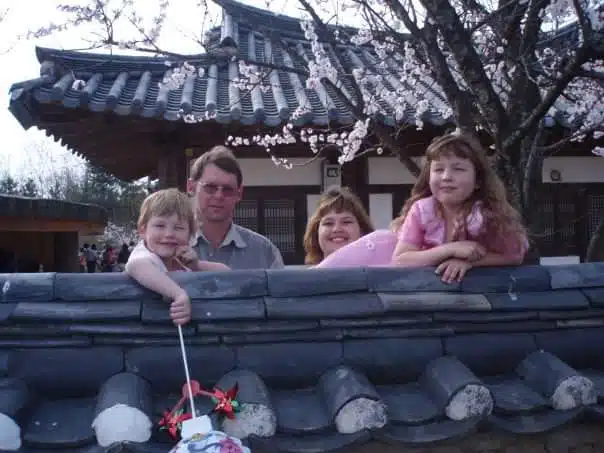
Learning is inclusive in public schools, so we taught special needs students alongside AP(Advanced Placement) students. This can be a challenge to embrace, so take the opportunity to make the most of the situation for all involved. We introduced a lot of realia, which is great fun, especially the ‘clothing’ lesson, as we are a tall family and the students are very small!
Our teaching responsibilities included creating our own materials, providing our own outlines, ensuring worksheets were copied before class, and developing continuous assessment. The homeroom teacher handled the summative assessment.
The focus was on building confidence and fluency, and fostering freedom using a variety of methodologies, including creative arts, with non-traditional activities welcomed to enhance student engagement. The students were typically not as economically empowered, so we were able to use every creative idea we had to create reusable materials.
Pay, hours, and the job market
In Suwon, where we were at an academy, we were expected to work a lot of overtime.
The rural salary was higher, about ₩2.5 million compared to ₩1.8 million.
We had free housing in both locations. In the city, we had a large 4-bedroom apartment. In contrast, the rural area provided a tiny two-room apartment.
Generally, the salary in rural areas is slightly lower, but as we went from private enterprise to an extensively funded program, the opposite was true for us.
Student attitudes and culture
In large cities, students tend to be more diverse, having been exposed to foreigners and different cultures, which leads to varying levels of motivation and engagement.
Rural students were fascinated by us tall, blonde foreigners, but both groups showed incredible respect for teachers. The South Korean society is based on honour and respect for the individual as well as the group, which is ingrained.
We truly felt supported in the rural areas, and the homeroom teachers followed up on our lessons to ensure reinforcement of teaching so that by the next lesson, we could build upon our previous foundation.
Both settings emphasise respect for teachers and a structured approach to learning.
The whole country held competitions on the same day, and we loved attending the Science and Math Olympiads, seeing the entire range of students creatively implementing their learning in ingenious ways. Although we didn’t need to attend these events, we did so out of love for our students and a desire to help develop our young children.
Lifestyle outside the classroom
There is naturally a higher cost of living in the urban areas, particularly in Seoul, which does affect disposable income. But, your range and variety of choice is also substantially enhanced. The discerning consumer can keep within a budget with no problem. But if you like bread, you will pay dearly for it!
Andong had a lower cost of living, allowing for savings and a more affordable lifestyle. There are also various types of markets, from mall outlets typical in any country, to fresh markets, which can be challenging when you first encounter them, to farmers’ markets, which we strongly preferred when purchasing fresh produce.
In our free time we travelled as a family and found many places of interest that were engaging for all of us. We attended cultural theatre, immersed ourselves in the time-honoured practices of the locals and were free to experience the rich cuisine and culture of each area.
We particularly enjoyed a lot of mountain climbing, swimming in freezing rivers of snowmelt in the spring and attending local festivals, including a circus in a cave that we had to get to by boat! There are many excellent museums, such as the Bee Museum, where you get to enter an enclosure full of bees, and they all settle on you — absolutely awe-inspiring! We also took a submarine ride down to the grey depths where there is no light. The children were allowed to ‘co-pilot’, which they thoroughly enjoyed.
All our experiences were budget-friendly, and the educational experiences for our children was worth every penny. As adults, we were on a steep experiential curve too and loved the variety and immersion of all these activities.
Challenges and rewards
Relationships
Our relationships with students differed. We were closely involved with individual students and their parents during our time at the hagwon. In the rural area, we were in a public school setting and needed to align with the national curriculum, so we tended to develop stronger relationships with the academic staff.
Both places have formal relationships until you make friends, after which we were privileged to share home-cooked meals and engage in team karaoke competitions.
In Suwon, there was a large expat community with various social groups and activities, and we could meet at clubhouses or visit cultural heritage sites together. However, as we were a family of four, we just loved the adventure of going out for the day.
The smaller, rural community fostered more profound and lasting friendships, and we were privileged to be part of numerous family gatherings that introduced us to the authentic culture and traditions.
Communication
One of the biggest challenges I faced while travelling was definitely communication. It can be pretty daunting at first! I remember when I first arrived in a new country; I realised that learning just a few basic phrases made a world of difference. It was like unlocking a door to a whole new world.
A word of advice: try to learn the language. Hangul is relatively easy to grasp the basics, and it really helps on the metro and when reading signage. However, aim to carry a photo of your home and your destination until you grasp the pronunciation to show the taxi or bus driver.
Read more: What It’s Like Teaching In South Korea Without Speaking Korean
Oh, and let me tell you, small blonde children are fantastic conversation starters! I’d often find myself chatting with locals who were curious about my kids. It was a great way to connect.
But don’t take things personally. When people are brusque or direct, it’s usually not about you; they don’t know you yet.
Dress code
When it comes to dress codes, you have to be sensitive, especially in traditional or religious sites. While some places are pretty liberal, others require modesty.
Culture
Above all, respect is key. If you’re unsure about someone’s social standing, it’s best to assume they’re senior to you.
I remember this vividly when my husband and I were bowing to people. He’s nearly two meters tall, so bowing lower than someone who’s only 150 cm was quite a sight! It took some effort, but it was a good reminder of the importance of humility in different cultures.
So, just keep these things in mind, and you’ll navigate those cultural waters much more smoothly!
Conclusion: finding the right fit
Young teachers or those who thrive in fast-paced environments and can get by on minimal sleep may prefer city teaching. The challenges include managing larger commuting distances, although transport is diverse, reliable and can be budget-friendly. There are many outlets for the sports enthusiast, from taekwondo classes to mountain walking, as it is called, further afield to a plethora of family-friendly outings, such as forests and water parks, which are a fantastic way to spend the day.
We loved the rural teaching, focusing on community, personal connections, and a quieter lifestyle. We were part of the Cultural Exchange Program and gave numerous talks in various high schools, promoting diversity and highlighting the exciting variations of different cultures. Challenges include resource limitations and potential isolation.
Personally, I preferred the rural setting for its community feel and the ability to make a significant impact on students’ lives. However, the choice between urban and rural teaching should align with your teaching style and personality.
Teaching in either environment can be incredibly rewarding. Embrace the challenges, stay open-minded, and remember that every experience contributes to your growth as an educator.
Author Bio
Teacher in the Field represents our TEFL Academy global community sharing their real-world experiences from classrooms and institutions across the world. From diving into TEFL to chomping down on chow mein in China, to navigating your first-day nerves in Spain, our collective voice brings authentic stories, insights, and practical advice right from those living the adventure.
Read
Teacher in the Field's story →
 United States
US
United States
US











 December 16, 2025