United States
US



Level 3 vs Level 5 TEFL: What’s The Difference & Which Is Better?



Last Updated
September 4, 2026


Table of Contents
- Introduction
- Level 3 vs Level 5 differences
- TEFL qualification levels
- What is a Level 3 TEFL?
- What is a Level 5 TEFL?
- Which level should you choose?
- The importance of accreditation
- What Level 3/5 doesn’t tell you
- Conclusion
Unsure whether to opt for a Level 3 or Level 5 TEFL course? The main difference is found in the depth of training: Level 3 courses provide basic TEFL training, whereas Level 5 courses offer more advanced and comprehensive training.
For casual teaching jobs, some online teaching roles, volunteering, or trying TEFL for the first time, an accredited Level 3 certificate is usually enough. If you’re planning on pursuing TEFL as a serious career, or want to keep your options open, a Level 5 qualification is usually your better option.
In this guide, we’ll compare Level 3 and Level 5 TEFL courses, including the typical course hours, qualification levels, cost, accreditation, teaching opportunities, and which one is the right pick for you.
| Level 3 TEFL | Level 5 TEFL | |
| Typical course length | 120 hours | 168+ hours |
| Difficulty | Introductory | Advanced |
| Ideal for | Casual teachers, volunteering, some online teaching roles | Individuals thinking of pursuing TEFL professionally |
| Course content | Core teaching skills | More advanced teaching skills |
| Teaching opportunities | Online, casual, some overseas roles | Broader range of roles |
| Cost | Typically lower | Usually higher |
| Degree required | No | No |
| Teaching experience required | No | No |
If you’re looking to pursue a professional teaching career, a Level 5 TEFL course is often your strongest option. If you’re just testing the waters, looking to volunteer abroad, or just teach more casually, a Level 3 TEFL is usually good enough.

Level 3 vs Level 5: Are they actually different?
Yes, they are!
The differences between the Level 3 and Level 5 TEFL courses come down to a few key areas:
- Content
- Course length
- The types of teaching roles they prepare you for
The good news is that both of them can help you start teaching English abroad or online.
You may also notice that the Level 5 course tends to be pricier than the Level 3.
But before your wallet makes the decision for you, it’s important that you carefully consider both options.
While one may be cheaper, it might not help you get where you want to be. In that case, it’s worth investing in your future by choosing the more expensive option.
But you don’t need to decide just yet.
Understanding TEFL qualification levels
You’re probably wondering: Level 3? Level 5? What about the levels in between?
The majority of TEFL courses are Level 3 or Level 5. Level 4 TEFL courses exist but aren’t usually advertised as such.
Let’s break down why that is:
In the UK, to be designated a particular level, TEFL courses need to be regulated by a government department.
When qualifications are regulated, they can be placed in the qualifications framework that ranks courses based on their level of difficulty.
Levels 1 and 2 are the lowest qualifications on the framework. These qualifications are equivalent to school diplomas, GCSEs, and entry-level vocational certificates. So, they’re not enough to train you professionally in any field.
What is a TEFL Level 3 equivalent to?
A Level 3 TEFL course is equivalent to A-levels, BTEC Nationals, International Baccalaureate, and Advanced Apprenticeship qualifications. The US equivalent is a high school diploma and a basic post-secondary technical certificate.
It’s the minimum TEFL qualification you can get. These courses equip you with the fundamental skills needed to teach English.
What is a TEFL Level 5 equivalent to?
In the UK qualifications framework, an accredited Level 5 TEFL course sits at the same level as qualifications like a Diploma of Higher Education and a foundation degree. The US equivalent is an Associate Degree.
Naturally, this doesn’t necessarily mean that a Level 5 TEFL certificate is the same qualification as a foundation degree or DipHE.
Why isn’t there a Level 4?
While Level 4 qualifications exist in the framework, it’s not common for TEFL courses to be at this level.
The Level 3 course prepares aspiring teachers to enter the field by teaching them the basic skills they need. The Level 5 course covers more advanced skills.
What is a Level 3 TEFL course?
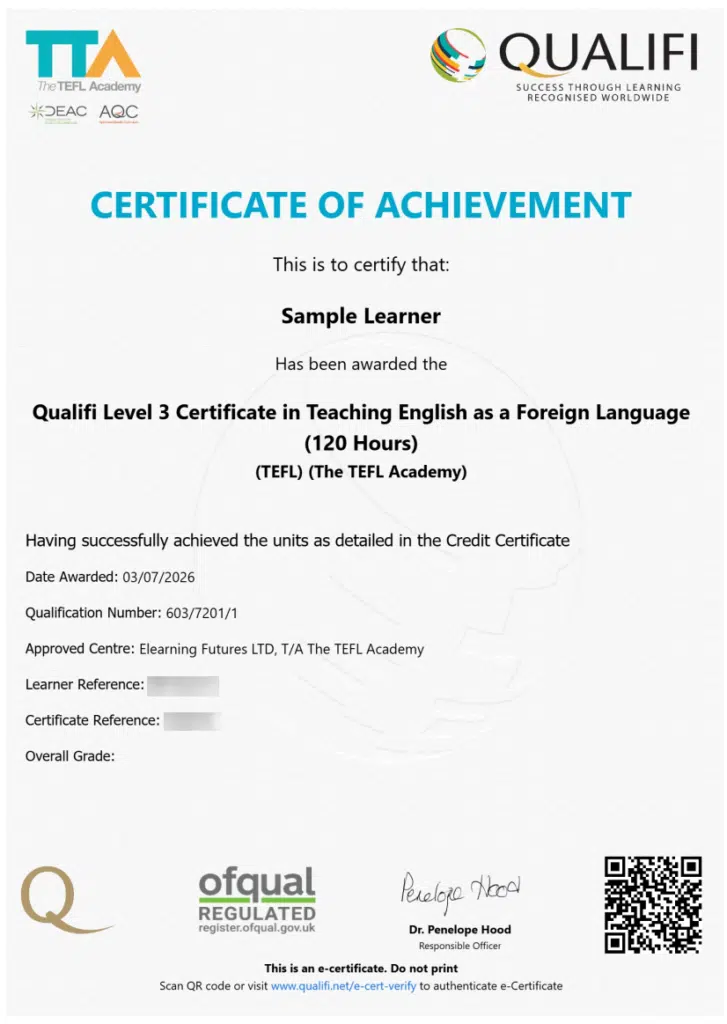
A Level 3 TEFL course is an introductory course to teaching English as a foreign language.
It covers the fundamentals of lesson planning, English grammar, and basic approaches to teaching vocabulary, pronunciation, and other essential language skills.
How many hours is a TEFL Level 3?
A Level 3 TEFL course typically involves 120 hours of training.
While this might seem daunting, it’s an industry standard, and anything below this is not considered a recognised qualification.
Completing this amount of training is essential as you gain the basic skills and knowledge that schools and employers require.
To give you an idea of what a Level 3 course looks like, The TEFL Academy offers a 120-hour online Level 3 course.
In addition to English grammar and lesson planning, you’ll learn how to:
- Teach online
- Teach listening and reading skills
- Teach speaking and writing skills
Level 3 courses are typically aimed at people interested in teaching but who want to try it out before fully committing.
Level 3 courses mainly help you find casual work teaching English while backpacking or volunteering.
These positions are often short-term, meaning that you don’t have to be tied down to one place for too long. This type of employment offers flexibility and valuable experience that can help you land better jobs down the line.
A Level 3 certificate can also get you some work teaching English online.
This option allows you to teach and travel with greater freedom since you can work from anywhere and still earn money.
Read more: How To Teach English Abroad In Your Gap Year
What is a Level 5 TEFL course?
Level 5 TEFL courses are more comprehensive since they cover topics in greater detail than Level 3 courses.
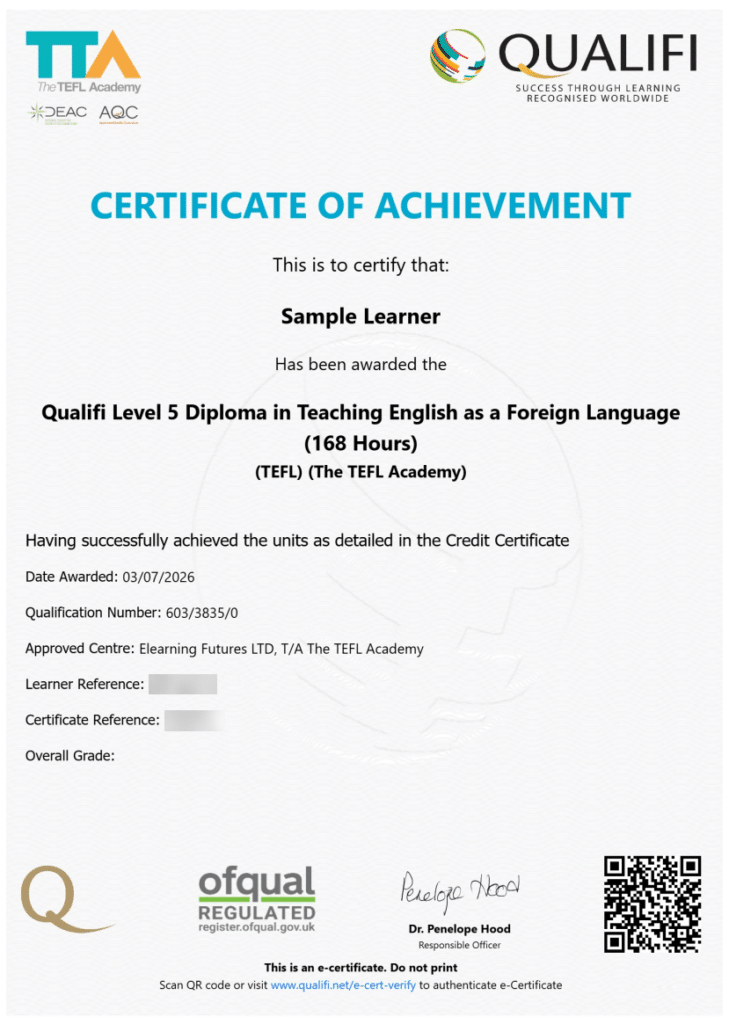
This is why you’ll find that Level 5 courses are advertised as taking at least 160 hours to complete. They are more advanced and designed to develop a broader range of skills to ensure that you’re fully prepared to step in front of a class.
In general, these courses cover lesson planning, teaching pronunciation, and developing skills in listening, reading, writing, and speaking.
But a good course should go beyond that.
For example, The TEFL Academy offers a 168-hour Level 5 TEFL course that not only teaches the standard teaching principles but also covers:
- English grammar in greater depth
- How to introduce new vocabulary
- Classroom management strategies
- How to develop your own collection of teaching resources
Level 5 courses prepare you for long-term employment, so they need to cover a wide range of content to prepare you for all the classes and ages you might need to teach.
With a Level 5 certificate, you can teach:
- Business English classes
- Online
- Private one-on-one classes
As well as in:
- Schools
- Universities/colleges
- Private language schools
- Businesses
Level 5 TEFL courses are aimed at anyone wanting a career in teaching English abroad or online.
Is Level 5 better than Level 3?
For the bulk of people looking to teach English professionally, a Level 5 certificate is the stronger option because it provides more extensive training and can help you meet the requirements of most jobs. However, a Level 3 can be a good option if you’re only looking to teach casually, volunteer, or dip your toes into the world of TEFL.
Read more: Is TEFL A Career?
Which TEFL level should you choose?
Deciding which is the best TEFL level for teaching abroad is difficult, but here is some advice:
You should consider enrolling in a Level 3 TEFL course if you:
- Are unsure if teaching is right for you,
- Want to only teach online classes part-time,
- Don’t want a career in teaching,
- Want to teach casually, or
- Want to volunteer.
Since they are shorter and cheaper than higher-level courses, they’re a great entry point into the industry. So, you can test the waters before investing a lot of time or money.
Who knows, you may just fall in love with teaching and the TEFL lifestyle!
But if you have a passion for education and travel (and you’re spending the money anyway!), the best TEFL level for teaching abroad is a Level 5 qualification.
This could apply to anyone who:
- Is new to teaching, but knows this is their calling,
- Has prior teaching experience, but wants to improve their skills or advance their career,
- Did a Level 3 course, but now wants to take teaching more seriously, or
- Wants to teach in a specific country.
It’s worth keeping in mind that a Level 5 certificate doesn’t automatically make you eligible for every teaching job. Employer requirements can vary wildly depending on the role and country. Some TEFL jobs may ask for a Bachelor’s degree, previous teaching experience, or a teaching licence in addition to a regulated TEFL qualification.
Read more: Is TEFL Hard To Pass?
When levels don’t matter: The importance of accreditation
When looking for a TEFL course, whether it’s Level 3 or 5, always make sure that the one you pick is internationally recognised and accredited.
TEFL accreditation ensures that the course meets industry standards and is offered by a reputable provider. So, you can rest assured that the course will cover everything you need.
If a course or certificate is internationally recognised, it means that the training you receive is legitimate and qualifies you to teach English almost anywhere in the world.
Without these two things, your qualification may not be accepted by schools or employers, so your hard work (and money) could go to waste.
Quick checklist: Use this 6-point checklist before buying any TEFL course to assess whether you’re making the right choice.
TEFL accreditation checklist: What to look for
Independent accreditation
- Is the course accredited by a recognised third party (eg Ofqual/TQUK) or approved by a government-recognised body (like the DEAC), rather than self-accredited by the provider itself?
Verified accreditation ID
- Does the course website provide a verifiable registration/accreditation number or a direct link to the accrediting body’s directory?
- You can view The TEFL Academy’s AQC status here and the Qualifi certificates here and here.
International recognition
- Is the certificate accepted for work visa applications and hiring processes in major TEFL destinations both abroad and online?
Rigorous quality control
- Does the accrediting agency regularly review course content, tutor qualifications, assessment methods, and student feedback?
Minimum standards met
- Does the program offer at least 120 hours of instruction (the global standard minimum required by most reputable schools)?
Authentic & verifiable certificate
- Will your final certificate include a unique reference/verification code or stamp that employers can verify online?
If the TEFL course satisfies these six points, then you can be reassured that the qualification is a good option for you.

What Level 3/5 doesn’t tell you
Having said all this, we want to make it clear that the level of your TEFL course is only one part of the picture.
The level of a course is especially important for a TEFL trainee, more so than for a TEFL employer. The level of a course puts a course on a framework created by the UK government. It’s a way of ascertaining the quality of a course and ensuring that it is going to teach you what it is supposed to. Employers look at the number of hours of a course, but also place a lot of value on the reputation of the course provider.
A Level 3 TEFL course will certainly prepare you for the EFL classroom, even if you have no prior teaching experience, but if you’re considering teaching English long-term or in a few different roles or in higher-paying positions, the Level 5 TEFL course is worth the investment. It gives your CV that extra little zhuzh.
No TEFL qualification can guarantee you a job. Finding a TEFL job requires the teacher to put in the legwork: putting together a relevant, detailed CV, finding and applying for appropriate jobs, turning up for and acing interviews, negotiating contracts, organising visas and more.
A TEFL qualification gives you the paperwork needed to apply for jobs, and a TEFL course provider can help you with finding job opportunities and tips and advice, but securing a teaching job online or abroad is ultimately in the hands of the teacher.
Conclusion: Picking the right TEFL course for you
Bottom line: Level 3 is your best option if you’re looking for an introduction to TEFL, or just plan on teaching casually. If you’re serious about making TEFL your career, Level 5 is the better investment because it provides more comprehensive training and can make you eligible for a broader range of jobs and opportunities.
Ultimately, the best TEFL course is one that matches your goals, budget, and availability.
While both Level 3 and Level 5 courses can help you start your TEFL journey, they lead to different opportunities.
But no matter which course you choose, remember to check that the course is accredited and internationally recognised. This way, you can trust that you’ll develop the skills and knowledge needed to become an effective teacher.
Soon enough, you’ll be teaching English and travelling the world!
Read more: Why I Chose An Internationally Recognised And Accredited TEFL Course
Author Bio
Table of Contents
- Introduction
- Level 3 vs Level 5 differences
- TEFL qualification levels
- What is a Level 3 TEFL?
- What is a Level 5 TEFL?
- Which level should you choose?
- The importance of accreditation
- What Level 3/5 doesn’t tell you
- Conclusion
Unsure whether to opt for a Level 3 or Level 5 TEFL course? The main difference is found in the depth of training: Level 3 courses provide basic TEFL training, whereas Level 5 courses offer more advanced and comprehensive training.
For casual teaching jobs, some online teaching roles, volunteering, or trying TEFL for the first time, an accredited Level 3 certificate is usually enough. If you’re planning on pursuing TEFL as a serious career, or want to keep your options open, a Level 5 qualification is usually your better option.
In this guide, we’ll compare Level 3 and Level 5 TEFL courses, including the typical course hours, qualification levels, cost, accreditation, teaching opportunities, and which one is the right pick for you.
| Level 3 TEFL | Level 5 TEFL | |
| Typical course length | 120 hours | 168+ hours |
| Difficulty | Introductory | Advanced |
| Ideal for | Casual teachers, volunteering, some online teaching roles | Individuals thinking of pursuing TEFL professionally |
| Course content | Core teaching skills | More advanced teaching skills |
| Teaching opportunities | Online, casual, some overseas roles | Broader range of roles |
| Cost | Typically lower | Usually higher |
| Degree required | No | No |
| Teaching experience required | No | No |
If you’re looking to pursue a professional teaching career, a Level 5 TEFL course is often your strongest option. If you’re just testing the waters, looking to volunteer abroad, or just teach more casually, a Level 3 TEFL is usually good enough.
Level 3 vs Level 5: Are they actually different?
Yes, they are!
The differences between the Level 3 and Level 5 TEFL courses come down to a few key areas:
- Content
- Course length
- The types of teaching roles they prepare you for
The good news is that both of them can help you start teaching English abroad or online.
You may also notice that the Level 5 course tends to be pricier than the Level 3.
But before your wallet makes the decision for you, it’s important that you carefully consider both options.
While one may be cheaper, it might not help you get where you want to be. In that case, it’s worth investing in your future by choosing the more expensive option.
But you don’t need to decide just yet.
Understanding TEFL qualification levels
You’re probably wondering: Level 3? Level 5? What about the levels in between?
The majority of TEFL courses are Level 3 or Level 5. Level 4 TEFL courses exist but aren’t usually advertised as such.
Let’s break down why that is:
In the UK, to be designated a particular level, TEFL courses need to be regulated by a government department.
When qualifications are regulated, they can be placed in the qualifications framework that ranks courses based on their level of difficulty.
Levels 1 and 2 are the lowest qualifications on the framework. These qualifications are equivalent to school diplomas, GCSEs, and entry-level vocational certificates. So, they’re not enough to train you professionally in any field.
What is a TEFL Level 3 equivalent to?
A Level 3 TEFL course is equivalent to A-levels, BTEC Nationals, International Baccalaureate, and Advanced Apprenticeship qualifications. The US equivalent is a high school diploma and a basic post-secondary technical certificate.
It’s the minimum TEFL qualification you can get. These courses equip you with the fundamental skills needed to teach English.
What is a TEFL Level 5 equivalent to?
In the UK qualifications framework, an accredited Level 5 TEFL course sits at the same level as qualifications like a Diploma of Higher Education and a foundation degree. The US equivalent is an Associate Degree.
Naturally, this doesn’t necessarily mean that a Level 5 TEFL certificate is the same qualification as a foundation degree or DipHE.
Why isn’t there a Level 4?
While Level 4 qualifications exist in the framework, it’s not common for TEFL courses to be at this level.
The Level 3 course prepares aspiring teachers to enter the field by teaching them the basic skills they need. The Level 5 course covers more advanced skills.
What is a Level 3 TEFL course?
A Level 3 TEFL course is an introductory course to teaching English as a foreign language.
It covers the fundamentals of lesson planning, English grammar, and basic approaches to teaching vocabulary, pronunciation, and other essential language skills.
How many hours is a TEFL Level 3?
A Level 3 TEFL course typically involves 120 hours of training.
While this might seem daunting, it’s an industry standard, and anything below this is not considered a recognised qualification.
Completing this amount of training is essential as you gain the basic skills and knowledge that schools and employers require.
To give you an idea of what a Level 3 course looks like, The TEFL Academy offers a 120-hour online Level 3 course.
In addition to English grammar and lesson planning, you’ll learn how to:
- Teach online
- Teach listening and reading skills
- Teach speaking and writing skills
Level 3 courses are typically aimed at people interested in teaching but who want to try it out before fully committing.
Level 3 courses mainly help you find casual work teaching English while backpacking or volunteering.
These positions are often short-term, meaning that you don’t have to be tied down to one place for too long. This type of employment offers flexibility and valuable experience that can help you land better jobs down the line.
A Level 3 certificate can also get you some work teaching English online.
This option allows you to teach and travel with greater freedom since you can work from anywhere and still earn money.
Read more: How To Teach English Abroad In Your Gap Year
What is a Level 5 TEFL course?
Level 5 TEFL courses are more comprehensive since they cover topics in greater detail than Level 3 courses.
This is why you’ll find that Level 5 courses are advertised as taking at least 160 hours to complete. They are more advanced and designed to develop a broader range of skills to ensure that you’re fully prepared to step in front of a class.
In general, these courses cover lesson planning, teaching pronunciation, and developing skills in listening, reading, writing, and speaking.
But a good course should go beyond that.
For example, The TEFL Academy offers a 168-hour Level 5 TEFL course that not only teaches the standard teaching principles but also covers:
- English grammar in greater depth
- How to introduce new vocabulary
- Classroom management strategies
- How to develop your own collection of teaching resources
Level 5 courses prepare you for long-term employment, so they need to cover a wide range of content to prepare you for all the classes and ages you might need to teach.
With a Level 5 certificate, you can teach:
- Business English classes
- Online
- Private one-on-one classes
As well as in:
- Schools
- Universities/colleges
- Private language schools
- Businesses
Level 5 TEFL courses are aimed at anyone wanting a career in teaching English abroad or online.
Is Level 5 better than Level 3?
For the bulk of people looking to teach English professionally, a Level 5 certificate is the stronger option because it provides more extensive training and can help you meet the requirements of most jobs. However, a Level 3 can be a good option if you’re only looking to teach casually, volunteer, or dip your toes into the world of TEFL.
Read more: Is TEFL A Career?
Which TEFL level should you choose?
Deciding which is the best TEFL level for teaching abroad is difficult, but here is some advice:
You should consider enrolling in a Level 3 TEFL course if you:
- Are unsure if teaching is right for you,
- Want to only teach online classes part-time,
- Don’t want a career in teaching,
- Want to teach casually, or
- Want to volunteer.
Since they are shorter and cheaper than higher-level courses, they’re a great entry point into the industry. So, you can test the waters before investing a lot of time or money.
Who knows, you may just fall in love with teaching and the TEFL lifestyle!
But if you have a passion for education and travel (and you’re spending the money anyway!), the best TEFL level for teaching abroad is a Level 5 qualification.
This could apply to anyone who:
- Is new to teaching, but knows this is their calling,
- Has prior teaching experience, but wants to improve their skills or advance their career,
- Did a Level 3 course, but now wants to take teaching more seriously, or
- Wants to teach in a specific country.
It’s worth keeping in mind that a Level 5 certificate doesn’t automatically make you eligible for every teaching job. Employer requirements can vary wildly depending on the role and country. Some TEFL jobs may ask for a Bachelor’s degree, previous teaching experience, or a teaching licence in addition to a regulated TEFL qualification.
Read more: Is TEFL Hard To Pass?
When levels don’t matter: The importance of accreditation
When looking for a TEFL course, whether it’s Level 3 or 5, always make sure that the one you pick is internationally recognised and accredited.
TEFL accreditation ensures that the course meets industry standards and is offered by a reputable provider. So, you can rest assured that the course will cover everything you need.
If a course or certificate is internationally recognised, it means that the training you receive is legitimate and qualifies you to teach English almost anywhere in the world.
Without these two things, your qualification may not be accepted by schools or employers, so your hard work (and money) could go to waste.
Quick checklist: Use this 6-point checklist before buying any TEFL course to assess whether you’re making the right choice.
TEFL accreditation checklist: What to look for
Independent accreditation
- Is the course accredited by a recognised third party (eg Ofqual/TQUK) or approved by a government-recognised body (like the DEAC), rather than self-accredited by the provider itself?
Verified accreditation ID
- Does the course website provide a verifiable registration/accreditation number or a direct link to the accrediting body’s directory?
- You can view The TEFL Academy’s AQC status here and the Qualifi certificates here and here.
International recognition
- Is the certificate accepted for work visa applications and hiring processes in major TEFL destinations both abroad and online?
Rigorous quality control
- Does the accrediting agency regularly review course content, tutor qualifications, assessment methods, and student feedback?
Minimum standards met
- Does the program offer at least 120 hours of instruction (the global standard minimum required by most reputable schools)?
Authentic & verifiable certificate
- Will your final certificate include a unique reference/verification code or stamp that employers can verify online?
If the TEFL course satisfies these six points, then you can be reassured that the qualification is a good option for you.
What Level 3/5 doesn’t tell you
Having said all this, we want to make it clear that the level of your TEFL course is only one part of the picture.
The level of a course is especially important for a TEFL trainee, more so than for a TEFL employer. The level of a course puts a course on a framework created by the UK government. It’s a way of ascertaining the quality of a course and ensuring that it is going to teach you what it is supposed to. Employers look at the number of hours of a course, but also place a lot of value on the reputation of the course provider.
A Level 3 TEFL course will certainly prepare you for the EFL classroom, even if you have no prior teaching experience, but if you’re considering teaching English long-term or in a few different roles or in higher-paying positions, the Level 5 TEFL course is worth the investment. It gives your CV that extra little zhuzh.
No TEFL qualification can guarantee you a job. Finding a TEFL job requires the teacher to put in the legwork: putting together a relevant, detailed CV, finding and applying for appropriate jobs, turning up for and acing interviews, negotiating contracts, organising visas and more.
A TEFL qualification gives you the paperwork needed to apply for jobs, and a TEFL course provider can help you with finding job opportunities and tips and advice, but securing a teaching job online or abroad is ultimately in the hands of the teacher.
Conclusion: Picking the right TEFL course for you
Bottom line: Level 3 is your best option if you’re looking for an introduction to TEFL, or just plan on teaching casually. If you’re serious about making TEFL your career, Level 5 is the better investment because it provides more comprehensive training and can make you eligible for a broader range of jobs and opportunities.
Ultimately, the best TEFL course is one that matches your goals, budget, and availability.
While both Level 3 and Level 5 courses can help you start your TEFL journey, they lead to different opportunities.
But no matter which course you choose, remember to check that the course is accredited and internationally recognised. This way, you can trust that you’ll develop the skills and knowledge needed to become an effective teacher.
Soon enough, you’ll be teaching English and travelling the world!
Read more: Why I Chose An Internationally Recognised And Accredited TEFL Course
Author Bio