 United States
US
United States
US










Teaching English to Kids in South Korea: Hours, Culture, Salaries & Challenges



Last Updated
December 11, 2025


Table of Contents
- Introduction
- Public schools vs hagwons
- Inside a Korean classroom
- Understanding school culture
- Advantages and challenges
- How to succeed
- Who thrives teaching kids?
Teaching English in Korea could be just what you’re looking for as your next adventure. Want to know why?
In a recent survey of 100 TEFL teachers from around the world, who teach English in South Korea:
93% rated their placements in South Korea as “Excellent” or “Good,”
and 100% reported adapting well to Korean culture.
The survey aimed to determine whether the perception that teaching English in South Korea is overly challenging is accurate. Happily, the stats revealed the opposite:
- 89% of teachers reported strong support from their schools
- 66% planned to stay another year
With those encouraging stats in mind, this guide dives into what it’s really like teaching kids in South Korea.
What ages you’ll teach in South Korean public schools vs. hagwons
Every person is different, so your experience will vary depending on whether you’re placed in a public school or a private academy (hagwon). Most teachers entering through the EPIK Programme or private contracts work with elementary-aged students.
- Public schools (EPIK / GOE Programme): Typical ages: 6–12 (elementary), occasionally 13–15 (middle school)
- Private academies (hagwons): Ages: 4–18, but most teachers work with elementary-aged students. Classes are smaller but more intensive.
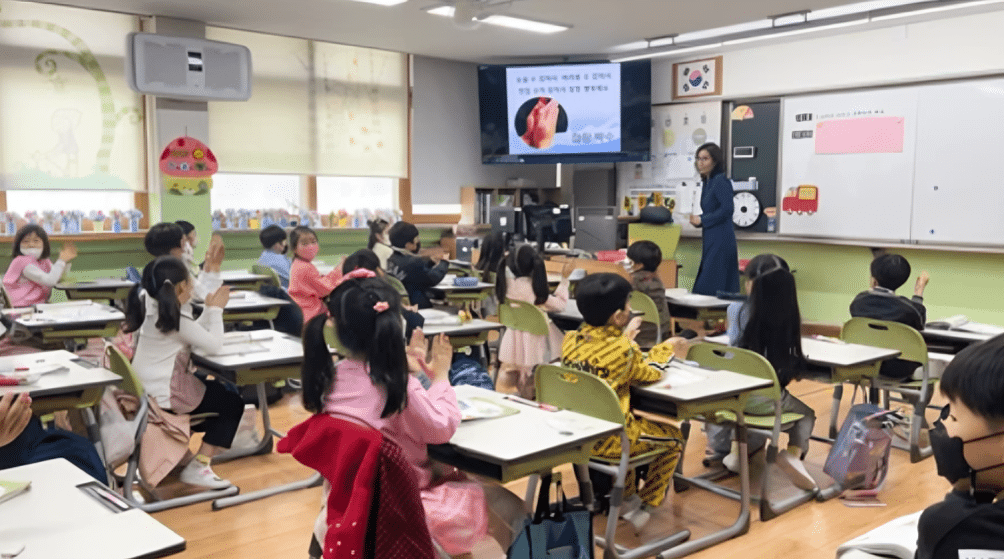
Inside a Korean classroom: Daily life, teaching style & student behaviour
Getting insight into different class environments will give you a solid understanding of what to expect when teaching. The overview below will give you a picture of what daily life usually looks like.
Curriculum
- Public schools: Use nationally prescribed textbooks. You’ll focus on speaking, writing, and listening activities.
- Hagwons: Some provide books, others expect you to add in your own activities along with the chosen book, while some may ask you to create your own lesson plans in accordance with their Hagwon’s curriculum.
- Tip for Hagwons: Hagwons are businesses, so be open to adapting to management’s feedback. Hagwons are flexible when it comes to content and lessons, as to retain their clients (parents).
Class size
- Public schools: 20 – 30 students per class in cities. In rural areas, classes are smaller. Multi-grade classrooms (more than one grade in a class) are quite common.
- Hagwons: 8 – 12 students. Smaller groups allow you more interaction with students, but more pressure to deliver measurable results (eg, students progressing from A1 to A2).
At my rural public school, there were only 17 students in total — yes, in the whole school! I had to teach Grades 3 and 4 together in one class, and most grades had fewer than 10 students. It was such a unique and rewarding experience, but also a challenge. Planning lessons that worked for kids at different levels took time, but I eventually figured out how to use multi-level games and creative activities to reach everyone.
Student energy
- Students are generally respectful, enthusiastic, and curious.
- Many are also tired due to long school and study hours, often attending both school and a hagwon daily.
- Classroom energy can be low during evening hours in hagwons.
- As students progress to higher grades, they tend to become more self-conscious and may act “too cool for school” in class. This is mainly the case in middle and high school.
Read more: Things To Know About Korean Classroom Culture
Teaching style
- Use TPR, visuals, songs, and storytelling.
- Keep activities short and varied.
- Repetition and praise build confidence.
Discipline
- Public schools: In some classrooms, the co-teacher is always present and takes an active role in teaching and/or managing student behaviour. In others, they may be absent for large portions of the lesson, leaving you to guide behaviour independently within cultural limits. It’s important to clarify this early!
Read more: Co-Teaching In The EFL Classroom
- Hagwons: In most cases, you are left in charge of classroom behaviour. Some hagwons do provide classroom management support from Korean staff.
In your first lesson with each class, create a classroom contract to set clear expectations. Kids love rewards, so incorporate that into your classroom contract too.
Tip: In big metros like Seoul and Busan, hagwon culture is fast-paced and competitive. Students are more focused and have more pressure to excel. In smaller cities like Jeonju or Chuncheon, you may find students are more relaxed, and class sizes are smaller. Oh! The perks of being in a smaller city!
Understanding Korean school culture as a foreign teacher
South Korea is a culturally homogeneous country, and this extends into its schools. Some things we do at work or in a social setting in our home country, could be seen as disrespectful in South Korea.
Being aware of the South Korean school culture will prevent you from unintentionally disrespecting someone and embarrassing yourself.
Read more: The Reality Of Teaching English in South Korea: What Nobody Tells You
Respect & hierarchy
Teachers are well respected by students and the public in South Korea. The caveat is that, as a foreign teacher, you’re often seen more as a guest than an authority figure. Korean students typically see your lessons as “a free lesson” or a lesson to play games, but they will be respectful and engaged.
Indirect communication
If a student makes a mistake, avoid direct criticism. Correct students gently and praise them for their effort. South Koreans are extremely self-conscious and have a culture of saving face, so students may avoid speaking up if they fear making mistakes in front of their classmates.
Group harmony
The concept of jeong (a deep sense of emotional connection and harmony) shapes social interactions. In class, prioritising group harmony will get students to feel more connected, where they will participate more naturally in class.
Collaborative activities work well, but avoid singling out students in ways that could embarrass them or disrupt unity.
Competition, marks, and points
Korean society is highly competitive. Using competition as a tool is your best modus operandi. Gamified lessons and point systems are great motivators, plus they work amazingly for classroom management.
When marking work, a check mark (✓) typically means something is incorrect, while a circle (⭕) means correct. Be mindful of this to avoid students freaking out or being confused.
Co-teacher relationships
In public schools, your relationship with your co-teacher/s will decide how you succeed and experience your job. I cannot stress how important communication with your co-teacher is. Clarify roles early and collaborate respectfully.
Tip: At the start of the semester, set up a shared Google Drive with lesson plans and slides. It helps co-teachers feel involved, even if they’re hands-off.
Advantages and challenges of teaching Young Learners in Korea
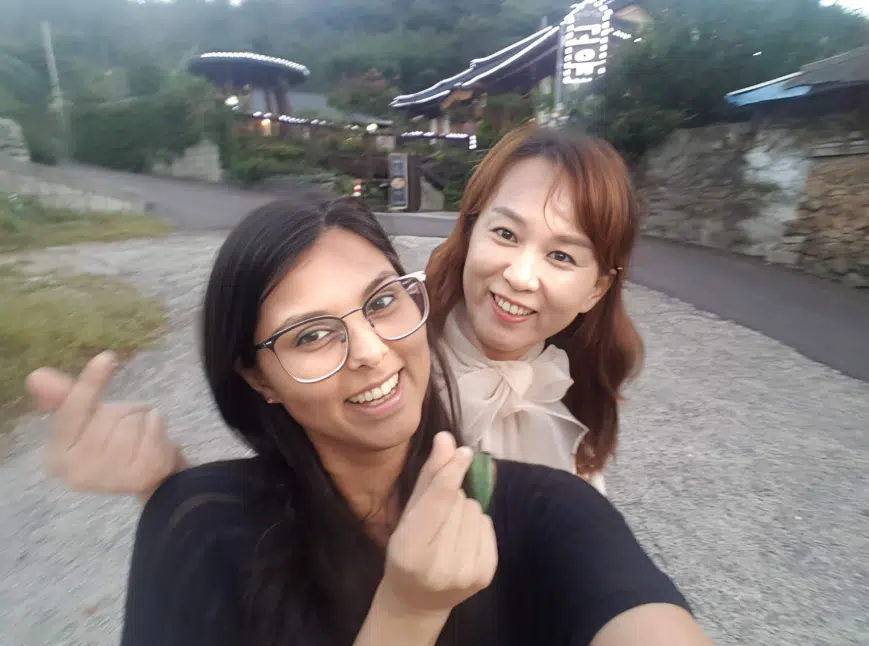
Teaching young Korean learners is fun. They are cute, full of beans, and excited to see and interact with a foreign teacher. Naturally, there will be some challenges, some of which are exciting to navigate, while others may be more trying depending on your personality or teaching style.
Read more: What’s The Difference Between Teaching Teenagers Vs Young Learners?
Let’s have a look at both sides of the coin:
Pros:
- Children are generally respectful, curious, and eager to learn.
- Lessons are fun! Young learners respond well to creative, interactive lessons using songs, games, and visuals.
- Children tend to be enthusiastic participants in group activities and enjoy competing in groups with one another.
- Lesson plans are easy to plan thanks to a structured curriculum, especially in public schools.
- You can see visible progress as students pick up new vocabulary and grow in confidence.
- South Korean children are adorable!
Cons:
- You need a lot of energy — children pick up on your mood, tone, and attitude. If you’re low-energy or disengaged, they will be too.
- The language barrier, especially with younger students, can make lesson delivery and classroom management more difficult.
- Kids may be low-energy or anxious due to academic pressure and long hours.
- Maintaining control and classroom discipline can be difficult without co-teacher support or when boundaries aren’t clearly established.
- Hagwon work hours can extend into the evening, which may not suit everyone’s lifestyle.
Expert advice: How to succeed as a foreign teacher in South Korea
These are the things I wish somebody had told me when I was exploring and landing my first job as a TEFL teacher in South Korea. The following tips will help set you up for success!
1. Don’t be a clown
Start off friendly and warm but firm. If you’re overly playful or animated at first, students may not respect your authority. This way, you can ease up later. Speaking from experience, it’s hard to take back control once it’s lost.
2. Negotiate expectations with your co-teacher
The level of involvement your co-teacher has in the classroom varies from job to job. Some want to share the teaching responsibilities, others want only to support you with classroom behaviour, and some just want to go to the breakroom.
Having a quick conversation at the beginning of your placement will prevent months of confusion and help build a smoother working relationship.
Clarify roles early on and ask your co-teacher/s:
- Will you be teaching the entire lesson or sharing it?
- What should I do if a student misbehaves while you’re not present?
- Can I create my own classroom rules and reward systems?
3. Learn basic Korean phrases
Learning some phrases of the local language related to the classroom helps with classroom management and builds trust. Try:
- “Sit down” – 앉으세요 (an-ju-se-yo)
- “Good job!” – 잘했어요! (jal-haess-eo-yo!)
- “Be quiet” – 조용히 하세요 (jo-yong-hi ha-se-yo)
4. Say yes to extra duties
Culture and duties will vary from school to school. In my school, all teachers would meet once a week in the school’s sports hall to play volleyball and eat fried chicken or kimbap.
From speaking tests to sporting events, extra duties might pop up now and then, which can help you form real relationships with both your colleagues and your students.
While you don’t always have to say yes, lending a hand is the best way to be part of the school, not just someone working at it. This advice is especially true in high schools, where the staff often come together to prepare students for exams and university.
Who thrives teaching kids in South Korea? Questions to ask yourself
I know some TEFL teachers who had originally said they didn’t like kids who had a life-changing experience teaching kids in South Korea. That being said, you know yourself better than anyone and should honestly ask yourself if it’s really for you.
Ask yourself these key questions before taking the leap:
- Do you enjoy teaching or interacting with children?
You’ll need energy, patience, and creativity every day. - Are you comfortable being out of your comfort zone?
Life in Korea is exciting but different. Cultural flexibility is essential. Culture shock is a reality for most ESL teachers and can either make or break your experience. - Can you stay calm when plans change?
Be ready for surprise schedule shifts and communication gaps. - Do you like structure and routine?
Korean classrooms follow a set curriculum, but there are lots of opportunities for creativity in lesson delivery. It’s ideal if you thrive on predictability, but can be creative within those bounds. - Are you looking for a meaningful, immersive experience?
Teaching Young Learners in South Korea can be one of the most enriching experiences of your life — if you’re prepared, curious, and ready to grow.
Author Bio
Table of Contents
- Introduction
- Public schools vs hagwons
- Inside a Korean classroom
- Understanding school culture
- Advantages and challenges
- How to succeed
- Who thrives teaching kids?
Teaching English in Korea could be just what you’re looking for as your next adventure. Want to know why?
In a recent survey of 100 TEFL teachers from around the world, who teach English in South Korea:
93% rated their placements in South Korea as “Excellent” or “Good,”
and 100% reported adapting well to Korean culture.
The survey aimed to determine whether the perception that teaching English in South Korea is overly challenging is accurate. Happily, the stats revealed the opposite:
- 89% of teachers reported strong support from their schools
- 66% planned to stay another year
With those encouraging stats in mind, this guide dives into what it’s really like teaching kids in South Korea.
What ages you’ll teach in South Korean public schools vs. hagwons
Every person is different, so your experience will vary depending on whether you’re placed in a public school or a private academy (hagwon). Most teachers entering through the EPIK Programme or private contracts work with elementary-aged students.
- Public schools (EPIK / GOE Programme): Typical ages: 6–12 (elementary), occasionally 13–15 (middle school)
- Private academies (hagwons): Ages: 4–18, but most teachers work with elementary-aged students. Classes are smaller but more intensive.
Inside a Korean classroom: Daily life, teaching style & student behaviour
Getting insight into different class environments will give you a solid understanding of what to expect when teaching. The overview below will give you a picture of what daily life usually looks like.
Curriculum
- Public schools: Use nationally prescribed textbooks. You’ll focus on speaking, writing, and listening activities.
- Hagwons: Some provide books, others expect you to add in your own activities along with the chosen book, while some may ask you to create your own lesson plans in accordance with their Hagwon’s curriculum.
- Tip for Hagwons: Hagwons are businesses, so be open to adapting to management’s feedback. Hagwons are flexible when it comes to content and lessons, as to retain their clients (parents).
Class size
- Public schools: 20 – 30 students per class in cities. In rural areas, classes are smaller. Multi-grade classrooms (more than one grade in a class) are quite common.
- Hagwons: 8 – 12 students. Smaller groups allow you more interaction with students, but more pressure to deliver measurable results (eg, students progressing from A1 to A2).
At my rural public school, there were only 17 students in total — yes, in the whole school! I had to teach Grades 3 and 4 together in one class, and most grades had fewer than 10 students. It was such a unique and rewarding experience, but also a challenge. Planning lessons that worked for kids at different levels took time, but I eventually figured out how to use multi-level games and creative activities to reach everyone.
Student energy
- Students are generally respectful, enthusiastic, and curious.
- Many are also tired due to long school and study hours, often attending both school and a hagwon daily.
- Classroom energy can be low during evening hours in hagwons.
- As students progress to higher grades, they tend to become more self-conscious and may act “too cool for school” in class. This is mainly the case in middle and high school.
Read more: Things To Know About Korean Classroom Culture
Teaching style
- Use TPR, visuals, songs, and storytelling.
- Keep activities short and varied.
- Repetition and praise build confidence.
Discipline
- Public schools: In some classrooms, the co-teacher is always present and takes an active role in teaching and/or managing student behaviour. In others, they may be absent for large portions of the lesson, leaving you to guide behaviour independently within cultural limits. It’s important to clarify this early!
Read more: Co-Teaching In The EFL Classroom
- Hagwons: In most cases, you are left in charge of classroom behaviour. Some hagwons do provide classroom management support from Korean staff.
In your first lesson with each class, create a classroom contract to set clear expectations. Kids love rewards, so incorporate that into your classroom contract too.
Tip: In big metros like Seoul and Busan, hagwon culture is fast-paced and competitive. Students are more focused and have more pressure to excel. In smaller cities like Jeonju or Chuncheon, you may find students are more relaxed, and class sizes are smaller. Oh! The perks of being in a smaller city!
Understanding Korean school culture as a foreign teacher
South Korea is a culturally homogeneous country, and this extends into its schools. Some things we do at work or in a social setting in our home country, could be seen as disrespectful in South Korea.
Being aware of the South Korean school culture will prevent you from unintentionally disrespecting someone and embarrassing yourself.
Read more: The Reality Of Teaching English in South Korea: What Nobody Tells You
Respect & hierarchy
Teachers are well respected by students and the public in South Korea. The caveat is that, as a foreign teacher, you’re often seen more as a guest than an authority figure. Korean students typically see your lessons as “a free lesson” or a lesson to play games, but they will be respectful and engaged.
Indirect communication
If a student makes a mistake, avoid direct criticism. Correct students gently and praise them for their effort. South Koreans are extremely self-conscious and have a culture of saving face, so students may avoid speaking up if they fear making mistakes in front of their classmates.
Group harmony
The concept of jeong (a deep sense of emotional connection and harmony) shapes social interactions. In class, prioritising group harmony will get students to feel more connected, where they will participate more naturally in class.
Collaborative activities work well, but avoid singling out students in ways that could embarrass them or disrupt unity.
Competition, marks, and points
Korean society is highly competitive. Using competition as a tool is your best modus operandi. Gamified lessons and point systems are great motivators, plus they work amazingly for classroom management.
When marking work, a check mark (✓) typically means something is incorrect, while a circle (⭕) means correct. Be mindful of this to avoid students freaking out or being confused.
Co-teacher relationships
In public schools, your relationship with your co-teacher/s will decide how you succeed and experience your job. I cannot stress how important communication with your co-teacher is. Clarify roles early and collaborate respectfully.
Tip: At the start of the semester, set up a shared Google Drive with lesson plans and slides. It helps co-teachers feel involved, even if they’re hands-off.
Advantages and challenges of teaching Young Learners in Korea
Teaching young Korean learners is fun. They are cute, full of beans, and excited to see and interact with a foreign teacher. Naturally, there will be some challenges, some of which are exciting to navigate, while others may be more trying depending on your personality or teaching style.
Read more: What’s The Difference Between Teaching Teenagers Vs Young Learners?
Let’s have a look at both sides of the coin:
Pros:
- Children are generally respectful, curious, and eager to learn.
- Lessons are fun! Young learners respond well to creative, interactive lessons using songs, games, and visuals.
- Children tend to be enthusiastic participants in group activities and enjoy competing in groups with one another.
- Lesson plans are easy to plan thanks to a structured curriculum, especially in public schools.
- You can see visible progress as students pick up new vocabulary and grow in confidence.
- South Korean children are adorable!
Cons:
- You need a lot of energy — children pick up on your mood, tone, and attitude. If you’re low-energy or disengaged, they will be too.
- The language barrier, especially with younger students, can make lesson delivery and classroom management more difficult.
- Kids may be low-energy or anxious due to academic pressure and long hours.
- Maintaining control and classroom discipline can be difficult without co-teacher support or when boundaries aren’t clearly established.
- Hagwon work hours can extend into the evening, which may not suit everyone’s lifestyle.
Expert advice: How to succeed as a foreign teacher in South Korea
These are the things I wish somebody had told me when I was exploring and landing my first job as a TEFL teacher in South Korea. The following tips will help set you up for success!
1. Don’t be a clown
Start off friendly and warm but firm. If you’re overly playful or animated at first, students may not respect your authority. This way, you can ease up later. Speaking from experience, it’s hard to take back control once it’s lost.
2. Negotiate expectations with your co-teacher
The level of involvement your co-teacher has in the classroom varies from job to job. Some want to share the teaching responsibilities, others want only to support you with classroom behaviour, and some just want to go to the breakroom.
Having a quick conversation at the beginning of your placement will prevent months of confusion and help build a smoother working relationship.
Clarify roles early on and ask your co-teacher/s:
- Will you be teaching the entire lesson or sharing it?
- What should I do if a student misbehaves while you’re not present?
- Can I create my own classroom rules and reward systems?
3. Learn basic Korean phrases
Learning some phrases of the local language related to the classroom helps with classroom management and builds trust. Try:
- “Sit down” – 앉으세요 (an-ju-se-yo)
- “Good job!” – 잘했어요! (jal-haess-eo-yo!)
- “Be quiet” – 조용히 하세요 (jo-yong-hi ha-se-yo)
4. Say yes to extra duties
Culture and duties will vary from school to school. In my school, all teachers would meet once a week in the school’s sports hall to play volleyball and eat fried chicken or kimbap.
From speaking tests to sporting events, extra duties might pop up now and then, which can help you form real relationships with both your colleagues and your students.
While you don’t always have to say yes, lending a hand is the best way to be part of the school, not just someone working at it. This advice is especially true in high schools, where the staff often come together to prepare students for exams and university.
Who thrives teaching kids in South Korea? Questions to ask yourself
I know some TEFL teachers who had originally said they didn’t like kids who had a life-changing experience teaching kids in South Korea. That being said, you know yourself better than anyone and should honestly ask yourself if it’s really for you.
Ask yourself these key questions before taking the leap:
- Do you enjoy teaching or interacting with children?
You’ll need energy, patience, and creativity every day. - Are you comfortable being out of your comfort zone?
Life in Korea is exciting but different. Cultural flexibility is essential. Culture shock is a reality for most ESL teachers and can either make or break your experience. - Can you stay calm when plans change?
Be ready for surprise schedule shifts and communication gaps. - Do you like structure and routine?
Korean classrooms follow a set curriculum, but there are lots of opportunities for creativity in lesson delivery. It’s ideal if you thrive on predictability, but can be creative within those bounds. - Are you looking for a meaningful, immersive experience?
Teaching Young Learners in South Korea can be one of the most enriching experiences of your life — if you’re prepared, curious, and ready to grow.
Author Bio