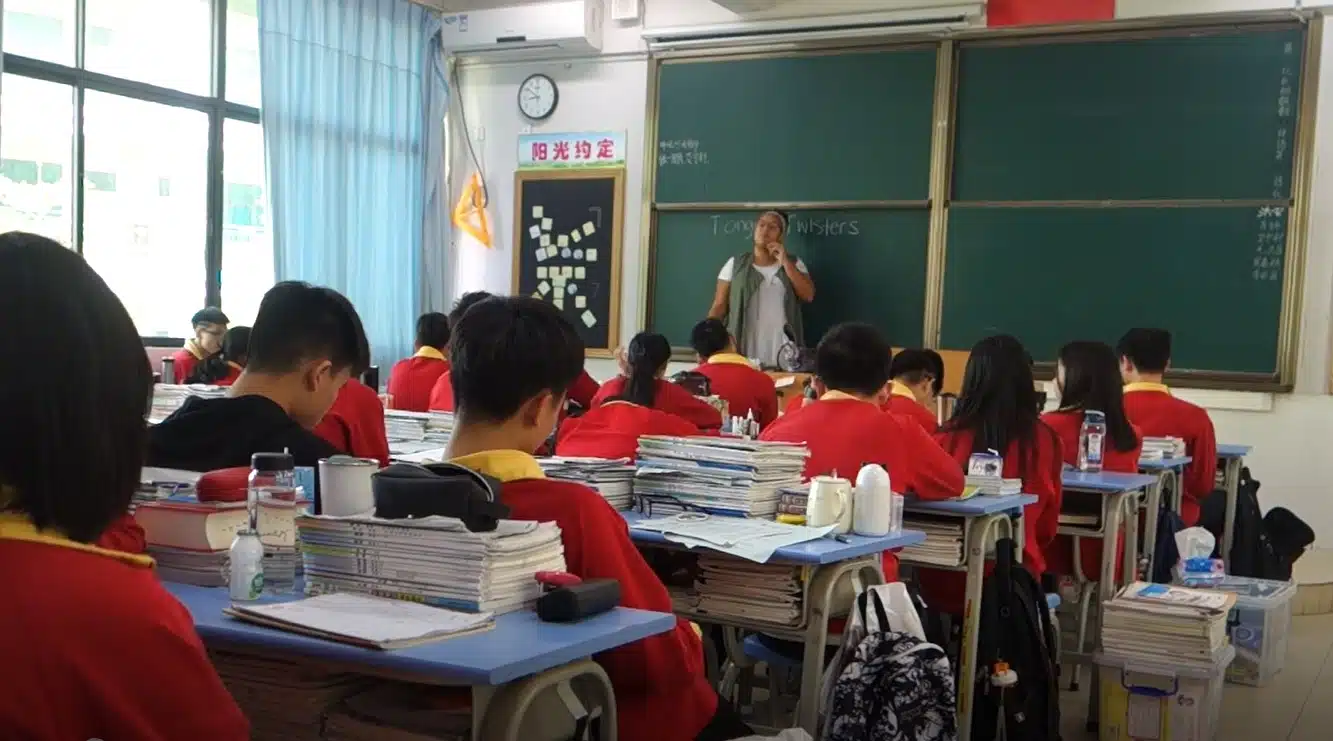
TEFL teacher Lauren is an American ESL teacher who has ten years’ experience as a TEFL teacher. She has been teaching in China since 2015. Here she draws on her experience with Chinese learners to tell us about the top pronunciation challenges for Chinese learners of English – and how to fix them.
Read more: How To Live And Work In China As A Foreigner

I originally decided to teach English because it would give me the opportunity to travel to a new place and experience a whole new culture but I have continued for the past 10 years because I love my role as an ESL teacher.
Every day I get to learn from my students and their culture and I get to share some of my own culture in my daily lessons. I grew to love that exchange, and that interaction is what keeps me loving my job and my life here in China.
Teaching English pronunciation to Chinese learners: Common hurdles & fixes
As you can imagine, English and Chinese are very different languages.
English uses an alphabet, changes word forms for tense and grammar, and relies heavily on word order. Chinese uses characters instead of an alphabet, uses tones to change meaning, and often relies more on context and particles rather than changing word endings.
They belong to completely different language families, which is why Chinese speakers often find learning English particularly challenging, and vice versa.
Let’s look at the biggest pronunciation challenges for Chinese learners of English.
Vowel distinctions
Students often confuse vowel sounds, leading to mispronunciation. For example, “ship” versus “sheep” and “snack” versus “snake” are common distinctions I highlight.
This is because Chinese vowel sounds are generally simpler than English vowel sounds. Some of our dipthong sounds don’t exist in Chinese
I find that emphasising these differences in a dramatic or funny way helps students remember them.
Silent letters and spelling-pronunciation mismatch
Silent letters are commonly mispronounced by Chinese students because there aren’t silent letters in the Chinese language. Students usually pronounce the silent letter and need to be reminded of the correct pronunciation.
I have a desert island lesson to have students engage their critical thinking in a fun way, and usually, in this lesson, I need to remind students of the correct pronunciation of “island,” but hopefully, after the class, they’ve got it ingrained in their memories!
Final consonants
It’s common for Chinese students to drop final sounds when speaking. Mandarin syllables typically end in vowels or nasals (/n/, /ŋ/), so final /t/, /d/, /s/ are often omitted or shortened.
This tends to cause some grammatical issues when they don’t pronounce the -ed sound of the past tense, the -s sound for plurals, or the third-person pronoun. For example, they might say I have three cat or Yesterday I watch a movie.
I often need to remind my intermediate students that when they do not fully pronounce the final sounds of words, this then affects their grammar.
My more advanced students are currently studying sustainability and renewable energy, so I often have to remind them to finish their words when speaking. For example, students often shorten the -y sound in words like “technology” and “energy”.
Th sounds (/θ/ and /ð/)
(eg, think, this)
I would say this is the most common pronunciation mistake.
Instead of pronouncing the th-sounds, learners may make an /s/ sound or drop the /h/ and just make a /t/ sound.
For example, “think” may be pronounced “sink” or “tink”. The number “three” may be said as “sree.”
This is because Mandarin has no dental fricatives, so learners substitute the /s/, /t/, or /d/ sounds.
H sound (/h/)
Some learners may drop or over-pronounce /h/, especially at the start of words. For example, Do you want a fried hegg? Or I live in a big ouse near the city.
Consonant clusters
English uses consonant clusters frequently, like in words like “street” or “splash”.
Learners tend to drop one or two consonants at the end of some words so that they are easier to say. This is known as consonant cluster deletion. For example, “friends” will be pronounced as “frens”, or “asked” as “ahs”.
When the cluster is at the beginning of a word, Chinese speakers might add in another syllable (the schwa /ə/) to make the consonant cluster easier to say. This is known as epenthesis, and can result in words like “sut-reet” or “su-plash”.
Intonation and word stress
Other problems Chinese learners may have when learning English pronunciation relate to suprasegmental issues.
Mandarin Chinese is a tonal language, and is syllable-timed whereas English is stress-timed.
Editor’s note: In syllable-timed languages, timing is determined by syllables. In stress-timed languages, timing is based on word stress.
Because of this, learners tend to pronounce all the syllables with the same stress and no distinction, which can come out quite flat and robotic-sounding.
This is a common thing I need to point out to my Intermediate university students who may be nervous when giving presentations. I need to remind them that I want to watch my human students presenting their ideas, not a machine.
Tips for pronunciation challenges for Chinese speakers
- Show students their pronunciation challenges. If it is a one-on-one lesson, I may repeat their pronunciation error, and they may notice it themselves once it’s reflected back at them. In a classroom setting, I demonstrate a sentence with common challenging words and ask students to point out words they struggle with, maybe with peer assessment involved.
- Use drilling. Chinese English learners are used to drill-type activities. This can be a familiar tool for them, which they can feel confident using. I have learned that it helps students practise the correct pronunciation.
- Tongue twisters. Tonuge twister exercises are a fun way for students to focus on their full pronunciation of words.
Recommended resources
Flashcards (or PPT slides for classroom lessons) are my favourite way to practice pronunciation. ESLbrains.com is my favourite website for lesson plans and classroom ideas. I often include pronunciation drills as a warm-up or close-out activity.
Final thoughts
For Chinese learners, saving face is a deeply held cultural belief, so teachers need to be careful when giving feedback on pronunciation challenges.
If a student learns they are making pronunciation mistakes, it can often lead them to worry about using correct pronunciation. They become so nervous that they never say anything out of fear of making a mistake and losing face in front of a native speaker.
Many new teachers may notice all the mistakes learners make and want to correct them all. It’s important to be mindful of students’ levels and be realistic when giving feedback and guidance in lessons.
Encouraging students to keep speaking without worrying about making mistakes should be prioritised over correcting every mistake. Encourage students that even with pronunciation mistakes, they can be understood and communicate successfully.
Read more: Why You Should Move To China To Teach English
Author Bio
Our Guest Authors represent our TEFL Academy global community, sharing their real-world experiences from classrooms and institutions across the world. From diving into TEFL to chomping down on chow mein in China, to navigating your first-day nerves in Spain, our collective voice brings authentic stories, insights, and practical advice right from those living the adventure.
Read
Guest Author's story →
 United States
US
United States
US