 United States
US
United States
US









Hi! I’m Lisa and I taught online for 3 years for a school in Vietnam and spent a large part of that time working with IELTS students. It was always an exciting journey to take with my students as we prepared for these tests, and so rewarding to hear of their scores and subsequent success.

A Guide To Teaching IELTS: How To Get Started
Join a global community of over 200,000 TEFL teachers working throughout the world! Enrol me!



Last Updated
September 15, 2026The IELTS test (International English Language Testing System) is one of the most recognised English Proficiency tests in the world. It’s an important test for students to take as it is a required aspect of some tertiary (and even secondary) education courses. Many students have to obtain certain band scores in order to apply to universities or private schools. Others are keen to work and/or study abroad, and require English proficiency in order to do so.
Did you know? More than 4 million IELTS tests were taken in 2023, in more than 100 countries.

This is a guide for teachers who are interested in teaching IELTS. In this blog post, we’ll look at
- Getting started & qualifications
- Income & career growth
- Pedagogy & assessment
Read more: Teaching English For Exams Vs General English
Getting started & qualifications
How do I become an IELTS teacher?
To begin with, your basic TEFL qualification will suffice. If you are keen to become an IELTS teacher, there are many courses available to enhance your credentials.
Do I need a special certification to teach IELTS?
You don’t need special certificates to teach IELTS, but if you want to specialise in it, there are various extra courses that you can do online to become more of an expert in the field. Besides taking a formal course you can also find loads of free resources and teaching materials online, such as free webinars from the British Council.
Do I need to be a native speaker to teach IELTS?
No, you don’t need to be a native speaker of English to teach IELTS but you need to have an Advanced, near-native level of English (C2 on the CEFR). Ultimately, if your English level is high enough to be a TEFL teacher, then it’s high enough to teach IELTS.
Can I teach IELTS without taking the exam myself?
Yes, you don’t have to take the IELTS exam yourself. It’s implied that if you teach English, you would be able to pass the IELTS test, and achieve a high band score. There are, however, free versions of the test that you can take for interest’s sake.
Of course, as an IELTS teacher you need to familiarise yourself with the whole IELTS test, as it is a very in-depth and quite varied. It comprises four sections: Listening, Reading, Writing and Speaking. Within these sections, there are different tasks and tests.
Test-takers are graded on a scale of 1 to 9 for each section, which gives you a combined score of 7/8 – 40 which results in a band score of 3-9. A band score of 3, for example, is “an extremely limited user”, a band score of 5 is “a modest user” and a band score of 9 is “an expert user”.
The Reading section is made up of three long texts and 40 comprehension questions. There are different versions of this part: the Academic version for higher education students and professionals, and some more everyday-focused texts for General entrants.
The Listening section (40 minutes) comprises four recorded items that the candidate only hears once. Then there are 40 worksheet questions that need to be filled in.
The Writing section (60 minutes) has two different parts. Firstly, for the Academic test, a chart, graph, table or diagram needs to be described. For the General test, a letter must be written. In the second part, test-takers write a longer opinion essay of 250 words. The topic and complexity of these tasks vary according to if they are in the Academic or General test.
The Speaking section (11-14 minutes) is made up of three parts. Part 1 has quick, fairly easy questions about topics that the student will know (general personal questions about hobbies, home, jobs.) Part 2 is an unprepared oral. The student is given a topic, one minute to prepare and then must speak alone for up to two minutes. This part can be particularly nerve-wracking, as a lot of pressure is on this vital, shorter portion. Part 3 delves deeper into the same topic from before, but requires more abstract ideas and opinions.
For more details on the IELTS exam, have a look at this blog post : Navigating the IELTS Exam: A Roadmap For Teachers
Income & career growth
Is teaching IELTS profitable for freelance TEFL teachers?
Teaching IELTS can be very profitable for freelance teachers. Because students need to take the tests, they need to get the practice. This is a recession-proof occupation as there are always immigration and study deadlines for students around the world, so a year-round demand exists. And often, IELTS students are more committed than other learners as their objectives are clearer.
How much can you charge for teaching IELTS?
Your teaching rate will depend on where you live and where your students are. But some IELTS teachers charge up to $30-$50+ /hour. Just a quick look on some online platforms and you can find IELTS teachers charging from $25 to $50, $60 and even $80 for a 50-minute online lesson.
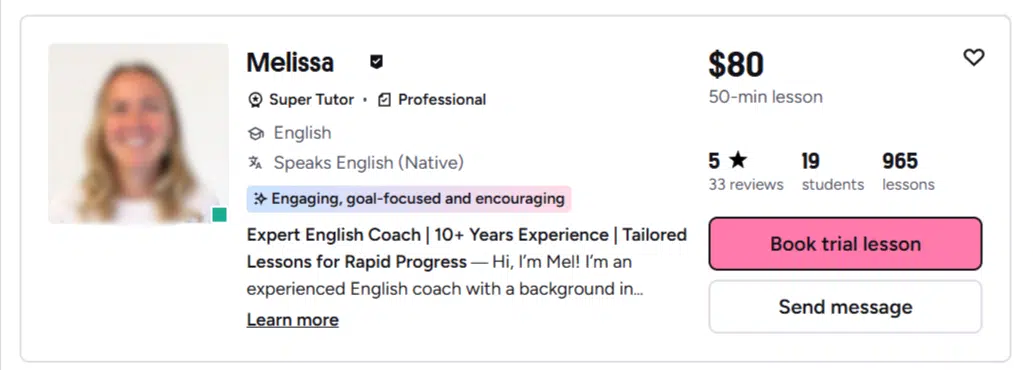
As with all specialised skills, you may find there is less competition for IELTS trainers, as not all TEFL teachers have the relevant training or experience. Even though you might start off with zero experience, it’s a good niche to specialise in because TEFL teachers are in high demand. Once you have experience, you can charge higher rates.
Read more: What Is English For Specific Purposes And How Do I Teach It?
How do I find students for IELTS exam preparation?
If this is something you want to nurture, then getting a recognised IELTS training certification will be beneficial – even if it’s free training. You can start marketing yourself by adding this competency to your CV and LinkedIn profile. You can sign up on online platforms such as Preply and italki and add IELTS to your offerings. If you already work for a school, let them know you have this extra expertise. And if you are looking for a first or new job, search for IELTS-specific schools, and language platforms that focus on Academic English. This could be a very good niche to get into.
Read more: Online Teaching Platforms You Need To Know
Pedagogy & assessment
What is the difference between General and Academic IELTS for teachers?
The exam skills for both IELTS exams are the same, but the difference is in the Reading and Writing sections. The Listening and Speaking tests are the same for everyone. The Reading and Writing exams use different texts and tasks. For teachers, this means ensuring students are familiar with the relevant text and task types.
For the Reading: the academic test uses longer, more formal texts from university-level materials. The General Training reading extracts are shorter and focused on practical, everyday pieces of writing, from advertisements to instruction manuals to job advertisement.
The Writing section asks that the academic students analyse visual data, while the general training activity is a semi-formal or formal letter.
Both exams do the same second written task, but the Academic task is more abstract, while the General task looks at broader, everyday content.
How do I teach IELTS if a student has low English proficiency?
How do you teach any student with a low English proficiency? Obviously, there are similarities between teaching a Level A1 student and an IELTS Band 3 student. Patience. As with any student, you work through the material with encouragement and diligence. Focus on core grammar, basic vocabulary and gentle test introduction.
Teaching Beginners of any age presents challenges, and you will learn to achieve success with practice. There is always graded material available for all levels to increase your students’ proficiency before they embark on the test. Break down the four sections into smaller bite-size pieces, expand vocabulary and practice listening and speaking tasks daily.
What score do students need in IELTS?
Not all students need the same scores. The score they need depends on their goal. Do they need an IELTS score for university? For a visa for immigration? For work?
Typically students require an overall score of:
- 6.0-6.5 for undergraduate university programs
- 6.5 – 7.0 for postgraduate university programs and
- 7.0-7.5 for top tier universities/institutions.
Although IELTS and CEFR are different methods of language grading, they are both globally recognised and can be aligned and compared to each other for a clearer overall understanding of English language levels:
| IELTS Band Score | CEFR Level |
| 8/9 | C2 |
| 7 – 8 | C1 |
| 5.5 – 6.5 | B2 |
| 4 – 5 | B1 |
| 3 | A2 |
| 2 | A1 |
Where can I find IELTS practice tests with answers?
There are lots of places to find sample tests with answers, as well as lists of discussion questions and ideas for lesson plans and activities. Highly recommended sites are the British Council and IELTS.org.
Overall, the time I spent working with IELTS students was amongst the most fulfilling of my teaching career. It is an area of EFL/ESL teaching that is interesting and rewarding. IELTS teachers can assist their students in achieving their goals and changing their lives.
This niche experience could help you land your dream job, whether online, at a school in your country or teaching abroad.
Author Bio

Accreditation & Quality Assurance
The TEFL Academy was the world’s first TEFL course provider to receive official recognition from government regulated awarding bodies in both the USA and UK. This means when you graduate you’ll hold a globally recognised Level 3 (120hr) Certificate or Level 5 (168hr) Diploma, meaning you can find work anywhere and apply for jobs immediately.


$
$