 United States
US
United States
US








The Truth About TAPIF: Salary, Placements, Accommodation & What Nobody Tells You



Last Updated
June 25, 2026


Table of Contents
- Introduction
- What is the TAPIF program?
- Eligibility requirements
- What TAPIF is really like
- TAPIF salary
- How to apply
- TAPIF placements explained
- TAPIF application
- Parting words
Being an assistant teacher in France is like a box of chocolates; you never know what you’re gonna get.
You’ve been sold the dream of cafe hopping, croissant-and-champagne breakfasts, and summer romance. But this guide is here to give you a much more realistic picture – to help you decipher if teaching in France is for you.
So if France is calling your name and you are looking for a gap year, teaching experience or a career change, this article is for you.
Read more: 13 Different Jobs For TEFL Teachers

What is the TAPIF program?
TAPIF stands for Teaching Assistant program in France.
It’s France’s government-led initiative that places native English speakers in French public schools to work as teaching assistants for seven months, from October 1st to April 30th.
Teaching Assistants work in primary, middle, and high schools to assist the main teacher.
The focus of the TAPIF program is on language learning, but also cultural exchange.
Who can apply for the TAPIF program?
TAPIF is specifically aimed at US citizens, but Canadians are also eligible to apply, with a slightly different application process.
For other nationalities, the same program is available under a different name. For example, South Africans can apply to be English teaching assistants in France through the English Language Assistants in France program.
What are the eligibility requirements of the TAPIF program?
- Age: 20-35 years old
- Citizenship: US citizens and US permanent residents
- Education:
- US: must have completed 3 years of university before the program begins
- French language proficiency: B1 level (CEFR). Applicants must be able to converse and write at an Intermediate French level, as well as to write a motivation letter as part of the application process.
- English language proficiency: Fluent/ native
- Criminal background check: clean, less than 3 months old
To boost your application:
- In/formal work experience: having worked with children in the capacity of babysitting, being a camp counsellor, etc., will strengthen your application.
- Travel experience: shows you are adaptable and open to other cultures.
- Teaching experience: a bonus too!
Note for Canadians: Eligibility requirements are nearly the same for Canadians, except they need to apply through France Éducation International or partner institutions in Canada, rather than through the US application portal.

What is it really like being a TAPIF teaching assistant in France?
Each TAPIF teaching assistant’s experience is different, so this is a difficult question to answer.
Reviews from social media, word of mouth, and discussion forums are vast and varied. Some TAPIF TAs (Teaching Assistants) boast about how enriching their experience has been, whilst others share not-so-rosy stories.
The lucky ones speak of how supportive their lead teachers are in the classroom, how expectations are clear, and how their workload is minimal. One TAPIF TA stated that their work schedule is from Tuesday to Thursday – a 3-day work week!
On the flip side, some TAPIF TAs have experienced the opposite:
- no clear expectations on their role in the classroom,
- having no support from their lead teacher,
- inconsistent schedules, and
- having extreme challenges in finding accommodation, opening a bank account, and registering for healthcare.
A big factor in what influences your stay in France is where you are placed. Being placed outside the city can be difficult for TAPIF TAs, where population sizes are small, and English proficiency is minimal. Living in a bustling city is the best mitigator of loneliness and feelings of isolation.
Read more: How to find your community as a TEFL teacher
TAPIF salary: How much do teaching assistants earn in France?
What is the salary of a TAPIF TA? You can expect to receive a modest stipend of €1010 ($1,150) before deductions, and +- €810 ($925) after deductions.
What about the benefits?
- 50% of TAPIF TAs who are placed at secondary schools get to board there for free or at a very small fee.
- +- 12 hours of work a week
- Healthcare coverage
- School holidays are yours to enjoy
- For TAPIF alumni, scholarships are available in the US and France, where tuition fees are covered between 30% and 100% :
- 15 US scholarships are available at universities such as Boston College, Columbia University, the CUNY Graduate Center, Middlebury, and New York University
- 6 French university scholarships
Reality check:
According to Villa-Albertine, the organisation which runs the TAPIF program, the stipend will allow you to” live the lifestyle of a typical undergraduate student in most regions”. So, if you are looking to save money, TAPIF will not afford you this. C’est la vie.
Your stipend will go to rent (if accommodation isn’t provided), food, transport – the bare necessities -and sometimes won’t even be enough to cover the basics. You may well have to dip into your savings to get by.
The biggest challenge for TAPIF TAs seems to be finding accommodation. If you are not fortunate enough to have the option to board at a school you teach in, you may struggle to find a place to stay, and having a language barrier makes the process even harder.
The bureaucratic processes of opening a bank account, securing your health insurance, and general assistance are not provided by the program. TAPIF TAs are left to handle their business, which is why having a good level of French will go a long way in these situations.
In short, TAPIF is best approached as a cultural and professional experience, not a financially lucrative opportunity.

How to apply for the TAPIF program
Once you have checked that you are eligible to apply to TAPIF, you can start getting your documents ready for submission.
What documents will I need to apply to TAPIF?
- Valid US passport or your US permanent resident card
- Academic transcripts (all 3 years)
- Clean criminal history report
- 500-word motivation letter in French
- Academic or professional referee
- Proof of French language proficiency:
- B1 level test scores from a standardised French-language test or a recommendation from a university French professor or teacher from the Alliance Française
NB: Your referee does not write a recommendation letter. TAPIF sends them a form to complete. The same goes for your proof of French proficiency if you are using a referee to vouch for your B1 French proficiency.
The TAPIF application process:
Applicants from the US will apply through Villa Albertine, the French Embassy’s cultural services organisation. Applications are submitted through the Submittable platform with a $149 application fee.
Canadians will apply through France Éducation International ($80 CAD application fee) or partner institutions in Canada. The application process is very similar to TAPIF, but there are some slight differences to be looked at here.
The TAPIF application process:
- Create a TAPIF profile
- Fill in your personal, work, and academic information
- Upload the required documents (academic transcripts, valid passport, criminal history report)
- Describe any teaching or supervisory experience you may have (babysitting, camp counsellor, coaching)
- Describe any experience you have working/studying abroad
- Choose how you will verify your French proficiency: test assessment scores or from a valid referee
- Write your 500-word motivation letter in French
- Input your referee’s details
- Choose 3 regional preferences
- Submit your application
- Pay the $149 application fee once you have received the email link
TAPIF placements explained: How French académies work
You are given the option of choosing three school districts, aka académies, as your placement preferences. You don’t choose a city, but a school district.
For example, many applicants make the mistake of thinking that if they opt for Toulouse, they will teach in the main city, when the school district is much bigger than the city centre, and they can be placed anywhere within it. So you could be placed in a big city, a small town, or in the countryside.
There are 30 académies to choose from:
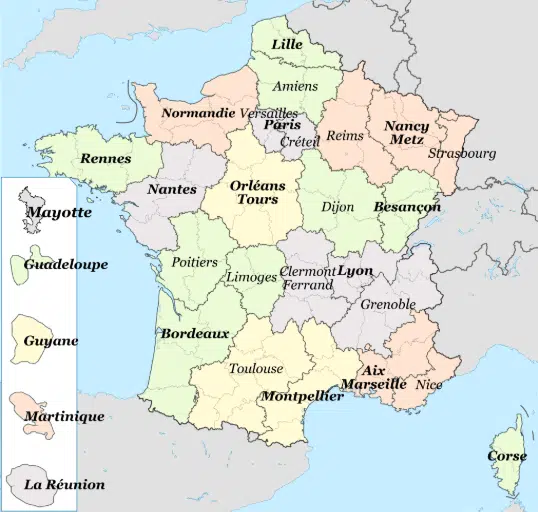
Source: https://commons.wikimedia.org/wiki/File:French_academies_map.svg
Note: despite having picked preferred académies, you may not get placed at any of them. This could be because your preferred académies are highly sought after by other applicants, making it super competitive. So, you could be placed in a rural area, or in a bustling metro, or something in between.
A hack for getting placed at your preferred location: Set up accommodation in that city already. You could get a family to host you in the city you want and inform TAPIF in your application.
Another hack for upping your chances of being placed in a city is to choose a less popular académie and opt for a city within it.
TAPIF application and timeline explained
TAPIF applications open in November and close in March.
After submitting your application, you will be emailed a link to pay the $149 pplication fee, which you should do as soon as possible. If you fail to pay before submissions close, your application will be voided.
In April, you will be told if your application has been successful and what academie you have been placed in. This is when your visa application process begins.
Your contract starts on the 1st of October. That’s where you get training and start working!
Parting words
Do your due diligence and ensure you have realistic expectations when embarking on this language program. Your experience will be better for it! Bonne chance!
Author Bio
Table of Contents
- Introduction
- What is the TAPIF program?
- Eligibility requirements
- What TAPIF is really like
- TAPIF salary
- How to apply
- TAPIF placements explained
- TAPIF application
- Parting words
Being an assistant teacher in France is like a box of chocolates; you never know what you’re gonna get.
You’ve been sold the dream of cafe hopping, croissant-and-champagne breakfasts, and summer romance. But this guide is here to give you a much more realistic picture – to help you decipher if teaching in France is for you.
So if France is calling your name and you are looking for a gap year, teaching experience or a career change, this article is for you.
Read more: 13 Different Jobs For TEFL Teachers
What is the TAPIF program?
TAPIF stands for Teaching Assistant program in France.
It’s France’s government-led initiative that places native English speakers in French public schools to work as teaching assistants for seven months, from October 1st to April 30th.
Teaching Assistants work in primary, middle, and high schools to assist the main teacher.
The focus of the TAPIF program is on language learning, but also cultural exchange.
Who can apply for the TAPIF program?
TAPIF is specifically aimed at US citizens, but Canadians are also eligible to apply, with a slightly different application process.
For other nationalities, the same program is available under a different name. For example, South Africans can apply to be English teaching assistants in France through the English Language Assistants in France program.
What are the eligibility requirements of the TAPIF program?
- Age: 20-35 years old
- Citizenship: US citizens and US permanent residents
- Education:
- US: must have completed 3 years of university before the program begins
- French language proficiency: B1 level (CEFR). Applicants must be able to converse and write at an Intermediate French level, as well as to write a motivation letter as part of the application process.
- English language proficiency: Fluent/ native
- Criminal background check: clean, less than 3 months old
To boost your application:
- In/formal work experience: having worked with children in the capacity of babysitting, being a camp counsellor, etc., will strengthen your application.
- Travel experience: shows you are adaptable and open to other cultures.
- Teaching experience: a bonus too!
Note for Canadians: Eligibility requirements are nearly the same for Canadians, except they need to apply through France Éducation International or partner institutions in Canada, rather than through the US application portal.
What is it really like being a TAPIF teaching assistant in France?
Each TAPIF teaching assistant’s experience is different, so this is a difficult question to answer.
Reviews from social media, word of mouth, and discussion forums are vast and varied. Some TAPIF TAs (Teaching Assistants) boast about how enriching their experience has been, whilst others share not-so-rosy stories.
The lucky ones speak of how supportive their lead teachers are in the classroom, how expectations are clear, and how their workload is minimal. One TAPIF TA stated that their work schedule is from Tuesday to Thursday – a 3-day work week!
On the flip side, some TAPIF TAs have experienced the opposite:
- no clear expectations on their role in the classroom,
- having no support from their lead teacher,
- inconsistent schedules, and
- having extreme challenges in finding accommodation, opening a bank account, and registering for healthcare.
A big factor in what influences your stay in France is where you are placed. Being placed outside the city can be difficult for TAPIF TAs, where population sizes are small, and English proficiency is minimal. Living in a bustling city is the best mitigator of loneliness and feelings of isolation.
Read more: How to find your community as a TEFL teacher
TAPIF salary: How much do teaching assistants earn in France?
What is the salary of a TAPIF TA? You can expect to receive a modest stipend of €1010 ($1,150) before deductions, and +- €810 ($925) after deductions.
What about the benefits?
- 50% of TAPIF TAs who are placed at secondary schools get to board there for free or at a very small fee.
- +- 12 hours of work a week
- Healthcare coverage
- School holidays are yours to enjoy
- For TAPIF alumni, scholarships are available in the US and France, where tuition fees are covered between 30% and 100% :
- 15 US scholarships are available at universities such as Boston College, Columbia University, the CUNY Graduate Center, Middlebury, and New York University
- 6 French university scholarships
Reality check:
According to Villa-Albertine, the organisation which runs the TAPIF program, the stipend will allow you to” live the lifestyle of a typical undergraduate student in most regions”. So, if you are looking to save money, TAPIF will not afford you this. C’est la vie.
Your stipend will go to rent (if accommodation isn’t provided), food, transport – the bare necessities -and sometimes won’t even be enough to cover the basics. You may well have to dip into your savings to get by.
The biggest challenge for TAPIF TAs seems to be finding accommodation. If you are not fortunate enough to have the option to board at a school you teach in, you may struggle to find a place to stay, and having a language barrier makes the process even harder.
The bureaucratic processes of opening a bank account, securing your health insurance, and general assistance are not provided by the program. TAPIF TAs are left to handle their business, which is why having a good level of French will go a long way in these situations.
In short, TAPIF is best approached as a cultural and professional experience, not a financially lucrative opportunity.
How to apply for the TAPIF program
Once you have checked that you are eligible to apply to TAPIF, you can start getting your documents ready for submission.
What documents will I need to apply to TAPIF?
- Valid US passport or your US permanent resident card
- Academic transcripts (all 3 years)
- Clean criminal history report
- 500-word motivation letter in French
- Academic or professional referee
- Proof of French language proficiency:
- B1 level test scores from a standardised French-language test or a recommendation from a university French professor or teacher from the Alliance Française
NB: Your referee does not write a recommendation letter. TAPIF sends them a form to complete. The same goes for your proof of French proficiency if you are using a referee to vouch for your B1 French proficiency.
The TAPIF application process:
Applicants from the US will apply through Villa Albertine, the French Embassy’s cultural services organisation. Applications are submitted through the Submittable platform with a $149 application fee.
Canadians will apply through France Éducation International ($80 CAD application fee) or partner institutions in Canada. The application process is very similar to TAPIF, but there are some slight differences to be looked at here.
The TAPIF application process:
- Create a TAPIF profile
- Fill in your personal, work, and academic information
- Upload the required documents (academic transcripts, valid passport, criminal history report)
- Describe any teaching or supervisory experience you may have (babysitting, camp counsellor, coaching)
- Describe any experience you have working/studying abroad
- Choose how you will verify your French proficiency: test assessment scores or from a valid referee
- Write your 500-word motivation letter in French
- Input your referee’s details
- Choose 3 regional preferences
- Submit your application
- Pay the $149 application fee once you have received the email link
TAPIF placements explained: How French académies work
You are given the option of choosing three school districts, aka académies, as your placement preferences. You don’t choose a city, but a school district.
For example, many applicants make the mistake of thinking that if they opt for Toulouse, they will teach in the main city, when the school district is much bigger than the city centre, and they can be placed anywhere within it. So you could be placed in a big city, a small town, or in the countryside.
There are 30 académies to choose from:
Source: https://commons.wikimedia.org/wiki/File:French_academies_map.svg
Note: despite having picked preferred académies, you may not get placed at any of them. This could be because your preferred académies are highly sought after by other applicants, making it super competitive. So, you could be placed in a rural area, or in a bustling metro, or something in between.
A hack for getting placed at your preferred location: Set up accommodation in that city already. You could get a family to host you in the city you want and inform TAPIF in your application.
Another hack for upping your chances of being placed in a city is to choose a less popular académie and opt for a city within it.
TAPIF application and timeline explained
TAPIF applications open in November and close in March.
After submitting your application, you will be emailed a link to pay the $149 pplication fee, which you should do as soon as possible. If you fail to pay before submissions close, your application will be voided.
In April, you will be told if your application has been successful and what academie you have been placed in. This is when your visa application process begins.
Your contract starts on the 1st of October. That’s where you get training and start working!
Parting words
Do your due diligence and ensure you have realistic expectations when embarking on this language program. Your experience will be better for it! Bonne chance!
Author Bio