 United States
US
United States
US








The Truth About Living in Vietnam as an English Teacher



Last Updated
January 29, 2026


Table of Contents
- Introduction
- Expectations of Vietnam
- Daily challenges
- Cultural differences
- Can I live on $1,000 a month?
- Social and expat scenes
- Culture shock
- Anything you wish you’d known?
- How has teaching in Vietnam shaped you?
- Would you recommend Vietnam?
David Parry went from working behind a bar in the UK to standing at the front of a classroom in Vietnam. Here he tells us the truth about living in Vietnam as an English teacher.
If you’ve ever thought about teaching English in Vietnam and wondered what your daily life will actually look like – be it the cost of living, the culture shock, or the work-life balance – this is my honest experience after more than six years living and teaching in Hanoi.
Working in bars and restaurants is exhausting; I know that from experience.
Through my late teens and early 20s, I worked in various such spots across my hometown, Liverpool, and got used to the grind. Working as a waiter was intended to be part-time, but after graduating from university in 2015, it quickly became full-time.
By the summer of 2018, I left the service industry to pursue a TEFL certificate with The TEFL Academy.
The following December, I was qualified, and by January 2019, I had reached my goal — I was teaching English to enthusiastic, energetic high school students in Hanoi, Vietnam.
Read more: Teach English in Vietnam
Does Vietnam live up to your expectations?
As one of the most exciting developing nations in the world, Vietnam is a spell-binding country. In the last decade, it’s become increasingly popular among tourists and expats.
Since arriving in the capital, Hanoi, I’ve spent the past six-and-a-half years deeply immersed in the Vietnamese lifestyle and culture.
Yet, I’m still often surprised and in awe of my experiences.
Read more: Things To Know About Vietnamese Classroom Culture
Vietnam has no shortage of tourist attractions.
For example, the natural wonders of Ha Long Bay, the sprawling metropolis of Ho Chi Minh City, and the unforgettable thrill of riding a motorbike around the Ha Giang Loop. Add to that beautiful beaches, bustling city streets, and monumental mountain ranges, and it’s easy to see why teachers like me stay for so long.
Read more: The Best Cities To Teach English In Vietnam
What’s a small daily challenge that took some getting used to?
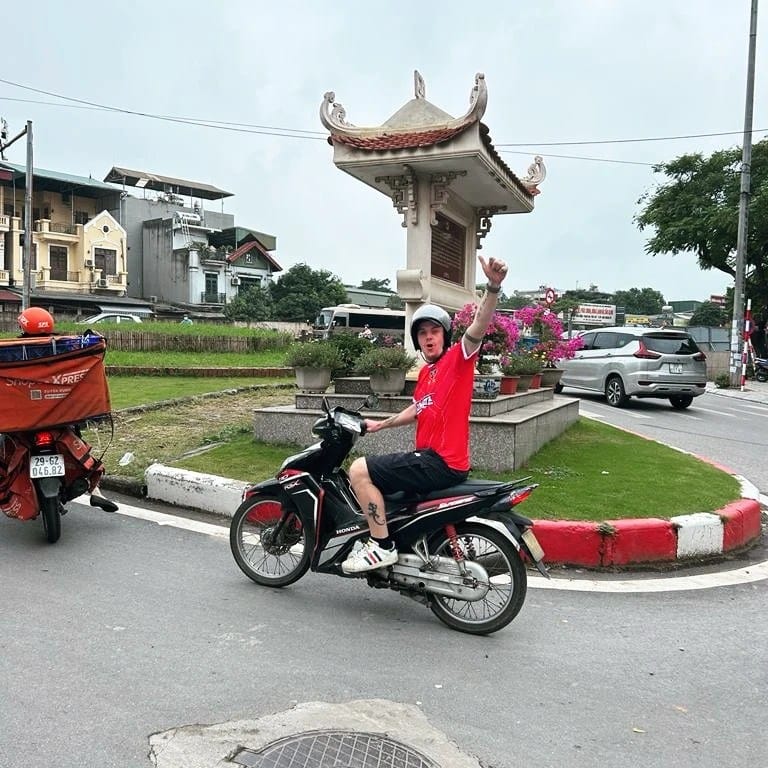
Easy answer — riding my motorbike.
No handbook will prepare you for the chaotic traffic in Hanoi, yet somehow it works, like organised chaos. Its unpredictability can be daunting at first, but you’ll quickly learn how to navigate your way through it all with ease.
Back in the UK, I was an avid cyclist, so I was beyond excited to learn how to ride a motorbike.
But nothing could have prepared me for the joy of weaving through the city’s traffic or cruising along Vietnam’s vast coastlines and landscapes. On the roads, I’ve seen it all: a fully grown elephant on a flatbed truck zooming down the highway and a family of four (including two dogs and a chicken) crammed onto a motorbike travelling through a mountain pass. I’ve even seen a guy with a kitchen sink strapped to his bike!
Scenes like these are just part of daily life in Vietnam.
This small “daily challenge” has become my favourite part of life in Hanoi — you may even start to wonder why you never rode a motorbike sooner.
Read more: A Day In The Life Of An English Teacher In Vietnam

Are there any cultural differences or unspoken rules?
Vietnamese people are truly one of a kind.
Their relationship with foreigners is pleasant, and they’re always hospitable and ready to lend a hand. They are remarkably resilient and resourceful, often showing kindness and generosity.
To give an example, let’s go back to the COVID-19 era of 2020–2021. Like many other expat teachers, I found myself suddenly stranded when my school was forced to close. The prospect of having to return to the UK was becoming real. But what happened next, I’ll never forget: a group of locals (colleagues, students’ parents, and the principal) offered me a place to live, rent-free.
Cultural differences and unspoken rules are things you’ll learn gradually.
I was blessed to have spent nearly one year living in Soc Son, a mountainous region 20km away from Hanoi. Living there was a unique experience, as I was the only foreigner in a small, tight-knit rural community where everyone knew each other.
Read more: What It’s Like Teaching In Vietnam: Rural Vs Urban Life Compared
Luckily, I lived near some Vietnamese colleagues who spoke fluent English, so communication wasn’t a problem. I even managed to learn a bit of Vietnamese.
Many friendly families lived on my street. Young children were fascinated by me, as most had never seen a Westerner. I was meant to be teaching teens at a high school, but found myself acting as a mentor and babysitter to these kids — they affectionately called me Thầy David (Teacher David).
I could write an entire story about my time in Soc Son, but for now, I’ll say this:
When I was in a difficult place, the Vietnamese people gave me a place to live, food, and a community. It’s one of the greatest acts of generosity I’ve ever received — I’ll never forget it.
It speaks to their goodwill, kind-hearted nature and ability to form positive relationships with foreign teachers.
Read more: Teaching English in Vietnam: 8 Reasons TEFL Teachers Love Calling Hanoi Home
Can I live on $1,000 a month in Vietnam as an English teacher?
If you’re teaching in Hanoi, you can expect to earn between đ23–53 million ($900–$2,200) a month, depending on your qualifications and experience. The cost of living is low, which means your income goes a long way, making a comfortable, even luxurious, lifestyle possible.
Read more: Teach English in Vietnam – Salaries
I work at a private school called The Dewey Schools as an elementary teacher. This position provides me with a much better work-life balance and financial situation than I ever had in the UK:
- I pay around đ8 million ($300) a month in rent.
- I spend on average đ3.2 million ($125) a week on necessities.
The price of a coffee or a sandwich is around £1, so I’ll let you do the math on how much you could save while working and living here.
Read more: What Is The Cost Of Living In Vietnam? We Asked Our Teachers
How have you found the social or expat scene?
Since 2019, I’ve been living in the popular expat district of Tay Ho, where the lifestyle is vibrant and multicultural. Nightlife thrives, social clubs flourish, and you can find food from every corner of the globe. Music, sports, weekly events: there’s something for everyone.
Most teachers come here to work hard, live peacefully, and explore Vietnamese culture.
In my free time, I love playing football. Hanoi offers plenty of opportunities to get a game in. Expats have even created a city-wide amateur competition called The HIFL: Hanoi International Football League.
The HIFL is a good example of what Vietnam’s expat community is all about: a place for locals and expats to connect, make friends, and create happy memories both on and off the football pitch.
Read more: How To Find Your Community As A TEFL Teacher
Have you experienced culture shock?
Being far from friends and family can be tough, but Hanoi’s expat scene is welcoming and makes the transition easier.
You’ll meet people from every background and find many opportunities to enjoy the social scene.
Still, there have been moments when I’ve questioned myself as to what I’m doing in Vietnam and what the future holds.
What kept me going was the sense of pride and achievement I felt when teaching. Students give you energy you never knew you had.
I’ve grown to love living and working in Hanoi. But funnily enough, when I’ve travelled to my hometown for holidays to visit family and friends, I’ve experienced a bit of a culture shock being back in the UK!
Once Vietnam captures your heart, you’ll never want to leave. But don’t worry, nothing is stopping you from video calling your friends and family back home.
On top of that, you can look forward to enjoying two to three months of summer holidays, giving you plenty of time to visit your hometown.
Read more: Navigating Culture Shock: My Real Experience Teaching English In Vietnam

Anything you wish you’d known before moving to Vietnam?
Good question. To be honest, I’m not even sure what I was expecting when I first arrived.
It does take a couple of weeks for most new expats to settle into the rhythm of life in Hanoi — but once you’re in, you’re in.
It’s probably wise to do your own research before moving here. Learn a bit about the history, the culture, the economy, and some basic language skills.
Read more: How To Learn The Local Language
Note from the editor: Here are some practical things you should know before moving to Vietnam:
- Bring earplugs — Vietnamese cities bustle from dawn to late at night. Add to that motorbikes, horns, street vendors, shop music, karaoke… You get the picture.
- Pack breathable clothing and rain gear. Vietnam is hot and humid year-round. You’ll also want to prevent soaked treks to school during the rainy season.
- Air quality can be poor. If you have allergies, check the Air Quality Index, especially in cities.
- Wifi can be patchy in areas — something to be aware of when renting.
- Reach for filtered water — tap water is a safety hazard.
- Students may be slow to warm up. Cultural differences mean they’re often shy, so patience is key.
- Explore cafés, bars, and karaoke bars — get ready to socialise the Vietnamese way.
- Download essential apps to stay connected. Two popular ones are Grab for transport and Zalo for messaging, especially if you want to connect with locals.
Read more: Everything You Need To Know About Teaching English In Vietnam
How has living and teaching in Vietnam shaped you?
Living in Vietnam as a TEFL teacher has improved my personal and professional life, my mental and physical health, and, without a doubt, my income. It has given me more options to advance in my career.
Most importantly, though it may sound like a cliché, living here has helped me grow and develop as a person: mind, body, and soul.
Read more: Teaching Kids in Vietnam: What It’s Really Like (+ Tips From a Teacher)
Would you recommend Vietnam to TEFL teachers?
Without a doubt, I recommend moving to Vietnam to anyone looking for a new challenge or a fresh start.
If you want to know more about my life in Hanoi, you can always follow and contact me on Instagram @teachwithdave.
Who knows? Before long, you could also find yourself enjoying life to the fullest while working as an international English teacher.
Author Bio
Table of Contents
- Introduction
- Expectations of Vietnam
- Daily challenges
- Cultural differences
- Can I live on $1,000 a month?
- Social and expat scenes
- Culture shock
- Anything you wish you’d known?
- How has teaching in Vietnam shaped you?
- Would you recommend Vietnam?
David Parry went from working behind a bar in the UK to standing at the front of a classroom in Vietnam. Here he tells us the truth about living in Vietnam as an English teacher.
If you’ve ever thought about teaching English in Vietnam and wondered what your daily life will actually look like – be it the cost of living, the culture shock, or the work-life balance – this is my honest experience after more than six years living and teaching in Hanoi.
Working in bars and restaurants is exhausting; I know that from experience.
Through my late teens and early 20s, I worked in various such spots across my hometown, Liverpool, and got used to the grind. Working as a waiter was intended to be part-time, but after graduating from university in 2015, it quickly became full-time.
By the summer of 2018, I left the service industry to pursue a TEFL certificate with The TEFL Academy.
The following December, I was qualified, and by January 2019, I had reached my goal — I was teaching English to enthusiastic, energetic high school students in Hanoi, Vietnam.
Read more: Teach English in Vietnam
Does Vietnam live up to your expectations?
As one of the most exciting developing nations in the world, Vietnam is a spell-binding country. In the last decade, it’s become increasingly popular among tourists and expats.
Since arriving in the capital, Hanoi, I’ve spent the past six-and-a-half years deeply immersed in the Vietnamese lifestyle and culture.
Yet, I’m still often surprised and in awe of my experiences.
Read more: Things To Know About Vietnamese Classroom Culture
Vietnam has no shortage of tourist attractions.
For example, the natural wonders of Ha Long Bay, the sprawling metropolis of Ho Chi Minh City, and the unforgettable thrill of riding a motorbike around the Ha Giang Loop. Add to that beautiful beaches, bustling city streets, and monumental mountain ranges, and it’s easy to see why teachers like me stay for so long.
Read more: The Best Cities To Teach English In Vietnam
What’s a small daily challenge that took some getting used to?
Easy answer — riding my motorbike.
No handbook will prepare you for the chaotic traffic in Hanoi, yet somehow it works, like organised chaos. Its unpredictability can be daunting at first, but you’ll quickly learn how to navigate your way through it all with ease.
Back in the UK, I was an avid cyclist, so I was beyond excited to learn how to ride a motorbike.
But nothing could have prepared me for the joy of weaving through the city’s traffic or cruising along Vietnam’s vast coastlines and landscapes. On the roads, I’ve seen it all: a fully grown elephant on a flatbed truck zooming down the highway and a family of four (including two dogs and a chicken) crammed onto a motorbike travelling through a mountain pass. I’ve even seen a guy with a kitchen sink strapped to his bike!
Scenes like these are just part of daily life in Vietnam.
This small “daily challenge” has become my favourite part of life in Hanoi — you may even start to wonder why you never rode a motorbike sooner.
Read more: A Day In The Life Of An English Teacher In Vietnam
Are there any cultural differences or unspoken rules?
Vietnamese people are truly one of a kind.
Their relationship with foreigners is pleasant, and they’re always hospitable and ready to lend a hand. They are remarkably resilient and resourceful, often showing kindness and generosity.
To give an example, let’s go back to the COVID-19 era of 2020–2021. Like many other expat teachers, I found myself suddenly stranded when my school was forced to close. The prospect of having to return to the UK was becoming real. But what happened next, I’ll never forget: a group of locals (colleagues, students’ parents, and the principal) offered me a place to live, rent-free.
Cultural differences and unspoken rules are things you’ll learn gradually.
I was blessed to have spent nearly one year living in Soc Son, a mountainous region 20km away from Hanoi. Living there was a unique experience, as I was the only foreigner in a small, tight-knit rural community where everyone knew each other.
Read more: What It’s Like Teaching In Vietnam: Rural Vs Urban Life Compared
Luckily, I lived near some Vietnamese colleagues who spoke fluent English, so communication wasn’t a problem. I even managed to learn a bit of Vietnamese.
Many friendly families lived on my street. Young children were fascinated by me, as most had never seen a Westerner. I was meant to be teaching teens at a high school, but found myself acting as a mentor and babysitter to these kids — they affectionately called me Thầy David (Teacher David).
I could write an entire story about my time in Soc Son, but for now, I’ll say this:
When I was in a difficult place, the Vietnamese people gave me a place to live, food, and a community. It’s one of the greatest acts of generosity I’ve ever received — I’ll never forget it.
It speaks to their goodwill, kind-hearted nature and ability to form positive relationships with foreign teachers.
Read more: Teaching English in Vietnam: 8 Reasons TEFL Teachers Love Calling Hanoi Home
Can I live on $1,000 a month in Vietnam as an English teacher?
If you’re teaching in Hanoi, you can expect to earn between đ23–53 million ($900–$2,200) a month, depending on your qualifications and experience. The cost of living is low, which means your income goes a long way, making a comfortable, even luxurious, lifestyle possible.
Read more: Teach English in Vietnam – Salaries
I work at a private school called The Dewey Schools as an elementary teacher. This position provides me with a much better work-life balance and financial situation than I ever had in the UK:
- I pay around đ8 million ($300) a month in rent.
- I spend on average đ3.2 million ($125) a week on necessities.
The price of a coffee or a sandwich is around £1, so I’ll let you do the math on how much you could save while working and living here.
Read more: What Is The Cost Of Living In Vietnam? We Asked Our Teachers
How have you found the social or expat scene?
Since 2019, I’ve been living in the popular expat district of Tay Ho, where the lifestyle is vibrant and multicultural. Nightlife thrives, social clubs flourish, and you can find food from every corner of the globe. Music, sports, weekly events: there’s something for everyone.
Most teachers come here to work hard, live peacefully, and explore Vietnamese culture.
In my free time, I love playing football. Hanoi offers plenty of opportunities to get a game in. Expats have even created a city-wide amateur competition called The HIFL: Hanoi International Football League.
The HIFL is a good example of what Vietnam’s expat community is all about: a place for locals and expats to connect, make friends, and create happy memories both on and off the football pitch.
Read more: How To Find Your Community As A TEFL Teacher
Have you experienced culture shock?
Being far from friends and family can be tough, but Hanoi’s expat scene is welcoming and makes the transition easier.
You’ll meet people from every background and find many opportunities to enjoy the social scene.
Still, there have been moments when I’ve questioned myself as to what I’m doing in Vietnam and what the future holds.
What kept me going was the sense of pride and achievement I felt when teaching. Students give you energy you never knew you had.
I’ve grown to love living and working in Hanoi. But funnily enough, when I’ve travelled to my hometown for holidays to visit family and friends, I’ve experienced a bit of a culture shock being back in the UK!
Once Vietnam captures your heart, you’ll never want to leave. But don’t worry, nothing is stopping you from video calling your friends and family back home.
On top of that, you can look forward to enjoying two to three months of summer holidays, giving you plenty of time to visit your hometown.
Read more: Navigating Culture Shock: My Real Experience Teaching English In Vietnam
Anything you wish you’d known before moving to Vietnam?
Good question. To be honest, I’m not even sure what I was expecting when I first arrived.
It does take a couple of weeks for most new expats to settle into the rhythm of life in Hanoi — but once you’re in, you’re in.
It’s probably wise to do your own research before moving here. Learn a bit about the history, the culture, the economy, and some basic language skills.
Read more: How To Learn The Local Language
Note from the editor: Here are some practical things you should know before moving to Vietnam:
- Bring earplugs — Vietnamese cities bustle from dawn to late at night. Add to that motorbikes, horns, street vendors, shop music, karaoke… You get the picture.
- Pack breathable clothing and rain gear. Vietnam is hot and humid year-round. You’ll also want to prevent soaked treks to school during the rainy season.
- Air quality can be poor. If you have allergies, check the Air Quality Index, especially in cities.
- Wifi can be patchy in areas — something to be aware of when renting.
- Reach for filtered water — tap water is a safety hazard.
- Students may be slow to warm up. Cultural differences mean they’re often shy, so patience is key.
- Explore cafés, bars, and karaoke bars — get ready to socialise the Vietnamese way.
- Download essential apps to stay connected. Two popular ones are Grab for transport and Zalo for messaging, especially if you want to connect with locals.
Read more: Everything You Need To Know About Teaching English In Vietnam
How has living and teaching in Vietnam shaped you?
Living in Vietnam as a TEFL teacher has improved my personal and professional life, my mental and physical health, and, without a doubt, my income. It has given me more options to advance in my career.
Most importantly, though it may sound like a cliché, living here has helped me grow and develop as a person: mind, body, and soul.
Read more: Teaching Kids in Vietnam: What It’s Really Like (+ Tips From a Teacher)
Would you recommend Vietnam to TEFL teachers?
Without a doubt, I recommend moving to Vietnam to anyone looking for a new challenge or a fresh start.
If you want to know more about my life in Hanoi, you can always follow and contact me on Instagram @teachwithdave.
Who knows? Before long, you could also find yourself enjoying life to the fullest while working as an international English teacher.
Author Bio