United States
US



Teaching International Students vs. Immigrants: What Teachers Need To Know



Last Updated
September 22, 2026


Table of Contents
- Introduction
- Meet Matt
- What's the difference?
- IEP, ESOL and ELL
- Who are these learners?
- Expectations on these students
- “Dream Job” or “Survival Tool”?
- “Past life” educations
- Invisible “life barriers”?
- EAP vs life skills
- Which type is right for you?
- Final thoughts
Teaching English to international students and teaching English to immigrants may sound similar, but the classroom experience can be extremely different. International students might be learning English to enrol in university or establish a career, whereas immigrant learners might need English for work, healthcare, family life, and everyday communication.
Having taught English abroad, online, and to immigrant learners in the US, I’ve seen first-hand how these different goals mould everything from lesson planning to classroom expectations.

Meet Matt
If you asked me how to characterise my life after college, I would answer with one word: TEFL.
What does that word mean to you? Well, for me, it has become part of who I am. I’ll break it down for you, though: Teach English as a Foreign Language. After getting TEFL-certified a few months after graduating from college, this concept of teaching English to non-native speakers has taken me all over the globe by living and working in different countries (Spain, South Korea, and Türkiye) while also teaching English online and spending each month in a different country.
Sprinkled throughout this time, I have spent time volunteering and teaching in TEFL centres around the East Coast of the US. I have been teaching English to immigrants and other non-native speakers within my community. It has been a great way to connect with people and help them further integrate into American society. So, if you are reading this and speak English as a first language in an English-majority country, I recommend giving TEFL at home a chance!
One of the biggest things we’ve learned from teaching English across different countries – and now looking more closely at the US context – is that not all English learners are working toward the same goal.
Read more: Can You Live In The US On An Online Teacher Salary?
A bit of housekeeping: It’s worth keeping in mind that “international student” and “immigrant student” describe different things. International students usually refer to someone studying in the US temporarily or on a student visa, whereas immigrant students can have a number of permanent or temporary immigration statuses.
Teaching International students vs Immigrant students: What’s the difference?
| International students | Immigrant students | |
| Why are they learning English? | Academic study and future career opportunities, general English improvement | Work, family, services, and navigating everyday life |
| Typical setting | University, IEP, pathway programmes and language centres | ESOL/community programmes, schools, or adult education |
| Main focus | Academic English or General English | General English |
| Educational background | Often familiar with traditional education | Ranges between highly educated and interrupted |
| Usual goals | University admission, essays, lectures, exams, general conversation | Employment, healthcare, schools, housing and daily communication |
| Time pressure | Often tied to academic/visa requirements | Normally ongoing rather than tethered to a particular deadline |
| Good teaching approach | EAP, academic writing, study skills on top of General English | Needs-based practical communication, role play, functional language |
International students come to the United States to learn English for academic progression or to learn General English while immersing themselves in the culture for a short time, whilst immigrant learners generally need English for everyday practical communication and integration.
IEP, ESOL and ELL: What's the difference?
On paper, terms like IEP (Intensive English program), ESOL (English for Speakers of Other Languages), and ELL (English Language Learner) seem straightforward. In reality, they represent students with very different timelines, pressures, and motivations. Understanding who these learners are and what they’re up against outside the classroom completely changes how you approach teaching.
IEP (Intensive English Program)
An IEP is a full-time, immersive language track designed for non-native speakers, often prospective university students or working professionals, focused on rapidly building academic and conversational fluency through regular English lessons.
Read more: What Is EAP?
ESOL (English for Speakers of Other Languages)
ESOL refers to broad, inclusive instruction that teaches English to individuals who already speak one or more native languages. It emphasises practical communication skills for navigating daily life, work, and community integration.
The term ESOL is often used interchangeably with EFL (English as a Foreign Language), but ESOL is more commonly used in the US.
ELL (English Language Learner)
Another term which is used all over the world, but you’re more likely to hear it in a North American context. An ELL is a non-native English speaker who is receiving tailored language support alongside their standard academic coursework. The term ELL is a student-centred educational classification used primarily in US K–12 schools.
Read more: How To Know If TEFL Is Right For You?
Who are these learners, and what is their legal “deadline” in the US?
At a broad level, English learners in the United States often fall into two main groups: international students and immigrant students. While they may sit in the same classroom, their situations couldn’t be more different.
International students
International students are typically in the US on an F-1 visa, which comes with very specific conditions. One of the most important is the requirement to maintain full-time enrollment in an academic program, often through an Intensive English Program (IEP) or a university pathway. Their legal right to stay in the country is directly tied to their academic performance and attendance. If they fall below full-time status or fail to meet program requirements, they risk losing their visa.
In other words, there’s a very real deadline attached to their progress. Their time in the US is limited, structured, and high-stakes.
Other options for international students include entering the US on a B1/B2 Visa or the ESTA Visa Waiver Program. This option is for international students who want to study English in the US for a short period of time. These options restrict the time in the classroom to fewer than 18 hours a week (for up to 6 months on the B1/B2 Visa and up to 90 days on the ESTA Visa Waiver Program).
While these students have restrictions on their studying, they are part-time students and are generally more laid-back than those students preparing for an exam. This group often includes students from non-English-speaking countries who decide to kill two birds with one stone: improve their English and holiday in the US. Immigrant students
Immigrant students, on the other hand, operate on a completely different timeline. This group includes individuals with permanent residency (Green Card holders), asylees, refugees, and others with various legal statuses. Unlike international students, their right to remain in the US is not tied to academic performance. There’s no expiration date on their stay based on how quickly they learn English.
However, that doesn’t mean there’s no pressure. If anything, the pressure is just less visible and often more intense.

What are the expectations on these students?
For international students, the pressure is structured and clearly defined. They need to attend class, pass their courses, and often achieve specific English proficiency levels (like TOEFL or IELTS benchmarks) to move forward academically. Many are working toward admission into US universities, and their English program is simply one step along that path.
Because of this, their relationship with English is often academic. They are focused on writing essays, understanding lectures, and participating in classroom discussions. There’s a clear end goal: complete the program, earn a degree, and potentially leverage that education into career opportunities.
For General English international students, there is no external pressure, so to speak. Their motivation is high, but they enjoy a low-stress learning environment.
Immigrant students face a very different kind of pressure. Their goal isn’t tied to a test score or a university acceptance letter. Instead, it’s tied to everyday life.
They need English to navigate systems – finding a job, speaking with their child’s teacher, understanding medical instructions, or even something as simple as grocery shopping. There’s no official “deadline,” but there is a constant, underlying urgency to integrate into society.
They are, in many ways, “New Americans,” building a life from the ground up. And English is not just an academic subject… It’s a survival tool.
Is the goal a “Dream Career” or a “Survival Tool”?
This difference in legal status and life situation leads to one of the biggest divides in the classroom: motivation.
For international students, learning English is often an investment in a future “dream career.” They’ve chosen to live and/or study abroad, often paying significant tuition fees, with the goal of gaining access to better educational and professional opportunities. Their motivation is typically long-term and goal-oriented.
They may be thinking about: getting into a specific university program, securing internships or job opportunities, or building an international career.
In many ways, they can be seen as “educational tourists” – not in a negative sense, but in the idea that they are temporarily immersing themselves in a system to gain something specific before moving on.
Immigrant students, however, are focused on navigating everyday scenarios. Their motivation is immediate and practical. They are not necessarily thinking about abstract future goals. They are thinking about what they need to function today.
This might include:
- Communicating at work
- Understanding legal or medical information
- Helping their children with school
This difference changes everything in terms of lesson planning. What feels relevant or urgent to one group may feel completely disconnected to the other.
How does “past life” education affect the lesson plan?
Another major factor that shapes the classroom is what students bring with them from their previous educational experiences.
International students often come from structured academic backgrounds. Many have strong literacy skills in their first language (L1), and they are familiar with classroom expectations, study habits, and formal learning environments. Even if their English level is lower, they understand how to be students.
This means teachers can often focus on transferring those existing skills into English: academic writing, critical thinking, note-taking, and test preparation. The language may be different, but the skills are the same.
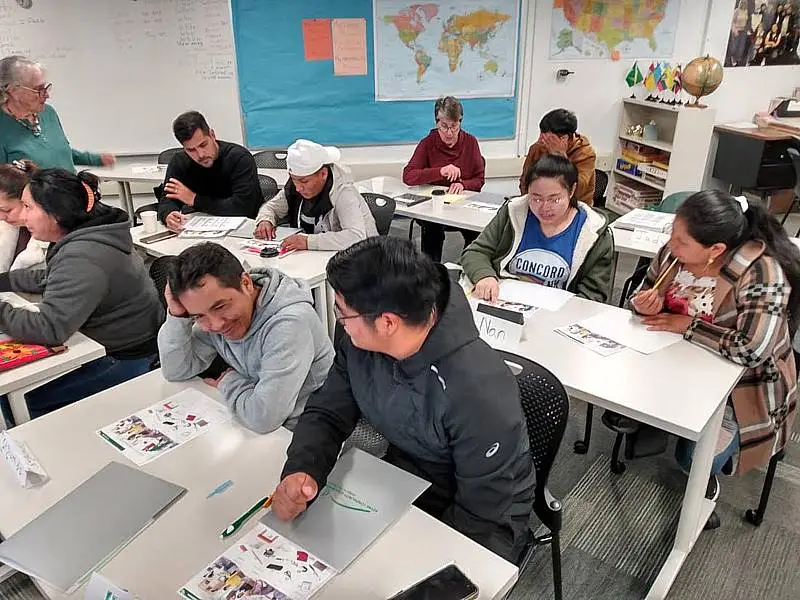
Immigrant students, however, represent a much wider spectrum of educational backgrounds. Some may have strong formal education in their home countries, while others fall into the category of SIFE (Students with Interrupted Formal Education).
SIFE students may have had limited or inconsistent access to schooling due to factors like conflict, economic hardship, or displacement. This can impact not only their English learning, but also their overall literacy and familiarity with classroom structures.
For these students, the challenge isn’t just learning English… It’s learning how to learn in a formal educational setting.
This requires a completely different approach: slower pacing, more foundational skill-building, and a greater emphasis on practical, real-world language.
It also requires a level of flexibility and awareness from the teacher. A lesson that works perfectly for a university-bound international student may be overwhelming or irrelevant for a SIFE learner.
What are the invisible “life barriers” happening outside the classroom?
One of the easiest mistakes to make as a teacher is to focus only on what happens inside the classroom. In reality, many of the biggest challenges English learners face have nothing to do with grammar or vocabulary.
The cost of living is a major factor, especially in the United States. International students are often dealing with high tuition fees, housing costs, and restrictions on employment due to visa regulations. Many are financially dependent on family support, which adds another layer of pressure to succeed academically.
Immigrant students, meanwhile, may be balancing work, family responsibilities, and financial instability. It’s not uncommon for students to attend classes after long work shifts or while managing childcare responsibilities.
Then there’s culture shock. Adjusting to life in the US can be overwhelming for both groups, but in different ways.
Read more: How To Deal With Culture Shock
International students may struggle with:
- Academic expectations
- Communication styles
- Social integration
Immigrant students may face:
- Language barriers in essential services
- Isolation from their community
- The emotional impact of starting over in a new country
These invisible barriers often show up in subtle ways – missed classes, lack of participation, or slower progress. Without understanding the context, it’s easy to misinterpret these as a lack of motivation.
In reality, they are often signs of students navigating challenges far beyond the classroom.

EAP vs life skills: What does a Monday morning actually look like?
If you walk into two English classrooms on a Monday morning, one focused on General English or EAP and the other on life skills ESOL, the lesson itself immediately reflects two very different priorities.
In an EAP classroom, the lesson might centre around analysing an academic article connected to a broader weekly theme. Students could begin by identifying the author’s main argument, highlighting key vocabulary, and then working in pairs to practice summarising or paraphrasing sections of the text.
From there, the class might transition into a short lecture clip where students take notes, followed by a writing task such as developing a thesis statement or outlining a response essay. Every part of the lesson is structured to build academic skills (critical thinking, organisation, and formal language use) because these students are preparing for university-level expectations.
In contrast, a Monday morning life skills ESOL lesson is built around immediate, real-world application. The class might start with a simple warm-up discussion about something students needed to do over the weekend, such as making an appointment or speaking to someone at work.
The teacher could then introduce a practical task, like role-playing a conversation with a doctor or filling out a basic job application. Vocabulary is introduced in context – phrases like “I’d like to schedule an appointment” or “I’m available to start immediately,” and students practice through repetition, interaction, and trial-and-error. The lesson often ends with a communicative activity where students apply what they’ve learned in a realistic scenario.
While the EAP classroom is building toward future academic success, the life skills classroom is focused on giving students the language they need to navigate their lives right now, and that difference shapes every part of what a Monday morning lesson looks like.
Which type of English teaching is right for you?
You may prefer teaching international students if…
- Are interested in meeting young adult students from all over the world,
- Enjoy helping students navigate Academic English, and
- Have experience teaching English for Exams.
You may prefer teaching immigrant students if…
- You are passionate about community integration and social equity,
- Want to help families find jobs, build careers and settle in the US, and
- Find fulfilment teaching General English to students who will walk out of your classroom and use what they have learnt immediately.
Can’t decide? You don’t need to!
A TEFL qualification allows you to do both! Whether it’s working in a language centre, an adult education centre, online or privately, all you ned is a TEFL certificate to qualify you to teach international and immigrant students.
Final thoughts
All in all, TEFL is a rewarding career no matter where in the world (abroad or in your home country) you are. You are opening the doors for whoever is learning the language: a young student in a foreign country, a fresh immigrant in your home, learners looking to take international jobs, and so on.
What that actually looks like on a day-to-day level, though, can vary more than most people expect.
Read more: 13 Different Jobs For TEFL Teachers
One day, you might be helping an international student refine an academic essay, preparing them for university lectures and long-term career goals. Next, you could be guiding a newly arrived immigrant through a simple conversation at the doctor’s office or helping them understand a job application.
Both are equally important, just in very different ways.
TEFL isn’t just about teaching grammar or vocabulary; it’s about understanding where your students are coming from, what they need right now, and where they’re trying to go. And once you start to see that, the job becomes a lot more than just teaching English; it becomes about helping people build opportunities, independence, and a sense of belonging in entirely new environments.
Author Bio
Table of Contents
- Introduction
- Meet Matt
- What's the difference?
- IEP, ESOL and ELL
- Who are these learners?
- Expectations on these students
- “Dream Job” or “Survival Tool”?
- “Past life” educations
- Invisible “life barriers”?
- EAP vs life skills
- Which type is right for you?
- Final thoughts
Teaching English to international students and teaching English to immigrants may sound similar, but the classroom experience can be extremely different. International students might be learning English to enrol in university or establish a career, whereas immigrant learners might need English for work, healthcare, family life, and everyday communication.
Having taught English abroad, online, and to immigrant learners in the US, I’ve seen first-hand how these different goals mould everything from lesson planning to classroom expectations.
Meet Matt
If you asked me how to characterise my life after college, I would answer with one word: TEFL.
What does that word mean to you? Well, for me, it has become part of who I am. I’ll break it down for you, though: Teach English as a Foreign Language. After getting TEFL-certified a few months after graduating from college, this concept of teaching English to non-native speakers has taken me all over the globe by living and working in different countries (Spain, South Korea, and Türkiye) while also teaching English online and spending each month in a different country.
Sprinkled throughout this time, I have spent time volunteering and teaching in TEFL centres around the East Coast of the US. I have been teaching English to immigrants and other non-native speakers within my community. It has been a great way to connect with people and help them further integrate into American society. So, if you are reading this and speak English as a first language in an English-majority country, I recommend giving TEFL at home a chance!
One of the biggest things we’ve learned from teaching English across different countries – and now looking more closely at the US context – is that not all English learners are working toward the same goal.
Read more: Can You Live In The US On An Online Teacher Salary?
A bit of housekeeping: It’s worth keeping in mind that “international student” and “immigrant student” describe different things. International students usually refer to someone studying in the US temporarily or on a student visa, whereas immigrant students can have a number of permanent or temporary immigration statuses.
Teaching International students vs Immigrant students: What’s the difference?
| International students | Immigrant students | |
| Why are they learning English? | Academic study and future career opportunities, general English improvement | Work, family, services, and navigating everyday life |
| Typical setting | University, IEP, pathway programmes and language centres | ESOL/community programmes, schools, or adult education |
| Main focus | Academic English or General English | General English |
| Educational background | Often familiar with traditional education | Ranges between highly educated and interrupted |
| Usual goals | University admission, essays, lectures, exams, general conversation | Employment, healthcare, schools, housing and daily communication |
| Time pressure | Often tied to academic/visa requirements | Normally ongoing rather than tethered to a particular deadline |
| Good teaching approach | EAP, academic writing, study skills on top of General English | Needs-based practical communication, role play, functional language |
International students come to the United States to learn English for academic progression or to learn General English while immersing themselves in the culture for a short time, whilst immigrant learners generally need English for everyday practical communication and integration.
IEP, ESOL and ELL: What's the difference?
On paper, terms like IEP (Intensive English program), ESOL (English for Speakers of Other Languages), and ELL (English Language Learner) seem straightforward. In reality, they represent students with very different timelines, pressures, and motivations. Understanding who these learners are and what they’re up against outside the classroom completely changes how you approach teaching.
IEP (Intensive English Program)
An IEP is a full-time, immersive language track designed for non-native speakers, often prospective university students or working professionals, focused on rapidly building academic and conversational fluency through regular English lessons.
Read more: What Is EAP?
ESOL (English for Speakers of Other Languages)
ESOL refers to broad, inclusive instruction that teaches English to individuals who already speak one or more native languages. It emphasises practical communication skills for navigating daily life, work, and community integration.
The term ESOL is often used interchangeably with EFL (English as a Foreign Language), but ESOL is more commonly used in the US.
ELL (English Language Learner)
Another term which is used all over the world, but you’re more likely to hear it in a North American context. An ELL is a non-native English speaker who is receiving tailored language support alongside their standard academic coursework. The term ELL is a student-centred educational classification used primarily in US K–12 schools.
Read more: How To Know If TEFL Is Right For You?
Who are these learners, and what is their legal “deadline” in the US?
At a broad level, English learners in the United States often fall into two main groups: international students and immigrant students. While they may sit in the same classroom, their situations couldn’t be more different.
International students
International students are typically in the US on an F-1 visa, which comes with very specific conditions. One of the most important is the requirement to maintain full-time enrollment in an academic program, often through an Intensive English Program (IEP) or a university pathway. Their legal right to stay in the country is directly tied to their academic performance and attendance. If they fall below full-time status or fail to meet program requirements, they risk losing their visa.
In other words, there’s a very real deadline attached to their progress. Their time in the US is limited, structured, and high-stakes.
Other options for international students include entering the US on a B1/B2 Visa or the ESTA Visa Waiver Program. This option is for international students who want to study English in the US for a short period of time. These options restrict the time in the classroom to fewer than 18 hours a week (for up to 6 months on the B1/B2 Visa and up to 90 days on the ESTA Visa Waiver Program).
While these students have restrictions on their studying, they are part-time students and are generally more laid-back than those students preparing for an exam. This group often includes students from non-English-speaking countries who decide to kill two birds with one stone: improve their English and holiday in the US. Immigrant students
Immigrant students, on the other hand, operate on a completely different timeline. This group includes individuals with permanent residency (Green Card holders), asylees, refugees, and others with various legal statuses. Unlike international students, their right to remain in the US is not tied to academic performance. There’s no expiration date on their stay based on how quickly they learn English.
However, that doesn’t mean there’s no pressure. If anything, the pressure is just less visible and often more intense.
What are the expectations on these students?
For international students, the pressure is structured and clearly defined. They need to attend class, pass their courses, and often achieve specific English proficiency levels (like TOEFL or IELTS benchmarks) to move forward academically. Many are working toward admission into US universities, and their English program is simply one step along that path.
Because of this, their relationship with English is often academic. They are focused on writing essays, understanding lectures, and participating in classroom discussions. There’s a clear end goal: complete the program, earn a degree, and potentially leverage that education into career opportunities.
For General English international students, there is no external pressure, so to speak. Their motivation is high, but they enjoy a low-stress learning environment.
Immigrant students face a very different kind of pressure. Their goal isn’t tied to a test score or a university acceptance letter. Instead, it’s tied to everyday life.
They need English to navigate systems – finding a job, speaking with their child’s teacher, understanding medical instructions, or even something as simple as grocery shopping. There’s no official “deadline,” but there is a constant, underlying urgency to integrate into society.
They are, in many ways, “New Americans,” building a life from the ground up. And English is not just an academic subject… It’s a survival tool.
Is the goal a “Dream Career” or a “Survival Tool”?
This difference in legal status and life situation leads to one of the biggest divides in the classroom: motivation.
For international students, learning English is often an investment in a future “dream career.” They’ve chosen to live and/or study abroad, often paying significant tuition fees, with the goal of gaining access to better educational and professional opportunities. Their motivation is typically long-term and goal-oriented.
They may be thinking about: getting into a specific university program, securing internships or job opportunities, or building an international career.
In many ways, they can be seen as “educational tourists” – not in a negative sense, but in the idea that they are temporarily immersing themselves in a system to gain something specific before moving on.
Immigrant students, however, are focused on navigating everyday scenarios. Their motivation is immediate and practical. They are not necessarily thinking about abstract future goals. They are thinking about what they need to function today.
This might include:
- Communicating at work
- Understanding legal or medical information
- Helping their children with school
This difference changes everything in terms of lesson planning. What feels relevant or urgent to one group may feel completely disconnected to the other.
How does “past life” education affect the lesson plan?
Another major factor that shapes the classroom is what students bring with them from their previous educational experiences.
International students often come from structured academic backgrounds. Many have strong literacy skills in their first language (L1), and they are familiar with classroom expectations, study habits, and formal learning environments. Even if their English level is lower, they understand how to be students.
This means teachers can often focus on transferring those existing skills into English: academic writing, critical thinking, note-taking, and test preparation. The language may be different, but the skills are the same.
Immigrant students, however, represent a much wider spectrum of educational backgrounds. Some may have strong formal education in their home countries, while others fall into the category of SIFE (Students with Interrupted Formal Education).
SIFE students may have had limited or inconsistent access to schooling due to factors like conflict, economic hardship, or displacement. This can impact not only their English learning, but also their overall literacy and familiarity with classroom structures.
For these students, the challenge isn’t just learning English… It’s learning how to learn in a formal educational setting.
This requires a completely different approach: slower pacing, more foundational skill-building, and a greater emphasis on practical, real-world language.
It also requires a level of flexibility and awareness from the teacher. A lesson that works perfectly for a university-bound international student may be overwhelming or irrelevant for a SIFE learner.
What are the invisible “life barriers” happening outside the classroom?
One of the easiest mistakes to make as a teacher is to focus only on what happens inside the classroom. In reality, many of the biggest challenges English learners face have nothing to do with grammar or vocabulary.
The cost of living is a major factor, especially in the United States. International students are often dealing with high tuition fees, housing costs, and restrictions on employment due to visa regulations. Many are financially dependent on family support, which adds another layer of pressure to succeed academically.
Immigrant students, meanwhile, may be balancing work, family responsibilities, and financial instability. It’s not uncommon for students to attend classes after long work shifts or while managing childcare responsibilities.
Then there’s culture shock. Adjusting to life in the US can be overwhelming for both groups, but in different ways.
Read more: How To Deal With Culture Shock
International students may struggle with:
- Academic expectations
- Communication styles
- Social integration
Immigrant students may face:
- Language barriers in essential services
- Isolation from their community
- The emotional impact of starting over in a new country
These invisible barriers often show up in subtle ways – missed classes, lack of participation, or slower progress. Without understanding the context, it’s easy to misinterpret these as a lack of motivation.
In reality, they are often signs of students navigating challenges far beyond the classroom.
EAP vs life skills: What does a Monday morning actually look like?
If you walk into two English classrooms on a Monday morning, one focused on General English or EAP and the other on life skills ESOL, the lesson itself immediately reflects two very different priorities.
In an EAP classroom, the lesson might centre around analysing an academic article connected to a broader weekly theme. Students could begin by identifying the author’s main argument, highlighting key vocabulary, and then working in pairs to practice summarising or paraphrasing sections of the text.
From there, the class might transition into a short lecture clip where students take notes, followed by a writing task such as developing a thesis statement or outlining a response essay. Every part of the lesson is structured to build academic skills (critical thinking, organisation, and formal language use) because these students are preparing for university-level expectations.
In contrast, a Monday morning life skills ESOL lesson is built around immediate, real-world application. The class might start with a simple warm-up discussion about something students needed to do over the weekend, such as making an appointment or speaking to someone at work.
The teacher could then introduce a practical task, like role-playing a conversation with a doctor or filling out a basic job application. Vocabulary is introduced in context – phrases like “I’d like to schedule an appointment” or “I’m available to start immediately,” and students practice through repetition, interaction, and trial-and-error. The lesson often ends with a communicative activity where students apply what they’ve learned in a realistic scenario.
While the EAP classroom is building toward future academic success, the life skills classroom is focused on giving students the language they need to navigate their lives right now, and that difference shapes every part of what a Monday morning lesson looks like.
Which type of English teaching is right for you?
You may prefer teaching international students if…
- Are interested in meeting young adult students from all over the world,
- Enjoy helping students navigate Academic English, and
- Have experience teaching English for Exams.
You may prefer teaching immigrant students if…
- You are passionate about community integration and social equity,
- Want to help families find jobs, build careers and settle in the US, and
- Find fulfilment teaching General English to students who will walk out of your classroom and use what they have learnt immediately.
Can’t decide? You don’t need to!
A TEFL qualification allows you to do both! Whether it’s working in a language centre, an adult education centre, online or privately, all you ned is a TEFL certificate to qualify you to teach international and immigrant students.
Final thoughts
All in all, TEFL is a rewarding career no matter where in the world (abroad or in your home country) you are. You are opening the doors for whoever is learning the language: a young student in a foreign country, a fresh immigrant in your home, learners looking to take international jobs, and so on.
What that actually looks like on a day-to-day level, though, can vary more than most people expect.
Read more: 13 Different Jobs For TEFL Teachers
One day, you might be helping an international student refine an academic essay, preparing them for university lectures and long-term career goals. Next, you could be guiding a newly arrived immigrant through a simple conversation at the doctor’s office or helping them understand a job application.
Both are equally important, just in very different ways.
TEFL isn’t just about teaching grammar or vocabulary; it’s about understanding where your students are coming from, what they need right now, and where they’re trying to go. And once you start to see that, the job becomes a lot more than just teaching English; it becomes about helping people build opportunities, independence, and a sense of belonging in entirely new environments.
Author Bio